
AWS Marketplace private offer automation: How to scale the full deal lifecycle

By Shweta RaoSep 30, 2026 · 13 min read

TL;DR

  • Private offers are how ISVs close enterprise deals on AWS Marketplace.

  • AWS Marketplace private offers have become more flexible, with Concurrent Agreements, Express Private Offers, Offer Sets, agreement-based offers, and configurable payment terms changing how enterprise deals can be structured.

  • As those options grow, private offer operations also become harder to manage manually across CRM, AWS Marketplace, finance, and channel teams.

  • Effective automation should cover the full lifecycle: offer creation, approvals, status tracking, agreements, payments, renewals, and CPPO attribution. The CRM should remain the system sellers work from, with marketplace data and actions connected back to the opportunity rather than managed through separate tickets and spreadsheets.

  • SaaSify brings these workflows into the CRM, with private offer automation in Salesforce and HubSpot, end-to-end CPPO automation in Salesforce, along with the newer AI and MCP-led marketplace workflows.

AWS Marketplace is becoming a larger part of how software companies grow. According to an IDC study, software vendors reported that their AWS Marketplace business grew 41% faster than their overall software business.

As more enterprise revenue moves through AWS Marketplace, private offers become a bigger part of how negotiated deals actually get closed, making it important to understand how they work before looking at where automation fits.
What is an AWS Marketplace private offer?

A private offer is how an ISV sells to a specific enterprise buyer on AWS Marketplace, with pricing, EULA terms, and a payment schedule that are different from the public listing.

The buyer reviews and accepts the offer through AWS Marketplace. AWS Marketplace then creates an agreement, which is what actually governs the purchase, including its status, its payment schedule, its renewal date, and any other custom terms attached to the deal.

There are two types of private offers to know:

  • A Marketplace Private Offer (MPPO) is one the ISV sends directly to a buyer.

  • A Channel Partner Private Offer (CPPO) is one a channel partner sends to a buyer, using a resale authorization the ISV has granted them.

Both get used for new deals, renewals, and expansions. Private offers exist because the public listing on AWS Marketplace rarely has the pricing or terms an enterprise buyer actually needs.

For ISVs handling a growing volume of enterprise marketplace deals, the challenge is not only creating the offer. Pricing, approvals, buyer acceptance, agreement status, payments, renewals, and channel attribution all need to stay connected to the original deal.

That is where private offer automation becomes useful: it reduces manual handoffs while keeping marketplace activity tied back to the CRM and the teams responsible for the customer.

What's changed in AWS Marketplace private offers in 2025 and 2026

Five AWS Marketplace changes materially affect how private offers can be structured and managed in 2026.

Concurrent Agreements (February 2026).

AWS Marketplace now allows multiple active agreements for the same SaaS product on one AWS account. New SaaS products have been required to support the updated requirements since June 1, 2026, while existing listings can opt in after migration to Amazon EventBridge. For automation, each agreement now needs to be tracked independently.

Express Private Offers (November 2025, extended to co-sell in June 2026).

Buyers can now get a private offer in minutes by answering a few questions, instead of going through a full sales negotiation. AWS evaluates their answers against pricing rules the seller has already set up.

In June 2026, AWS extended Express Private Offers into the co-sell motion, allowing AWS sellers to share Express Private Offer links with customers. ISVs still need to onboard eligible products and configure the pricing and qualification rules that govern which buyers receive an automated offer.

For ISVs, this creates another pricing path that needs to stay governed alongside negotiated private offers.

Offer Sets

Sellers can now group two to seven private offers together for the same buyer, so a multi-product deal can be sent and accepted as a single transaction. Each product still gets its own separate agreement once the buyer accepts, so the buyer can manage and renew each product on its own later.

Agreement-based offers

A new private offer can now be built directly from an existing agreement. This helps with renewals and mid-contract changes, since the seller does not have to start from a blank form.

Net payment terms (August 2026)

Sellers can now set Net 30, Net 45, Net 60, or Net 90 payment terms directly on a private offer, instead of defaulting to the buyer's standard AWS payment terms.

For CPPO deals, the ISV sets a maximum payment term, and the channel partner can offer anything at or below that. Payment terms therefore become another offer-level field that needs to flow correctly from the commercial agreement into AWS Marketplace and downstream payment tracking

AWS Marketplace now handles more of the deal

The recent AWS Marketplace changes have one thing in common: more of the commercial deal can now be structured and managed directly within the marketplace.

That now includes:

  • Pricing: Private offers support negotiated pricing, while Express Private Offers add rules-based pricing for eligible deals.

  • Multi-product deals: Offer Sets allow multiple products to be packaged into a single transaction.

  • Payment terms: Configurable payment terms bring another part of the commercial agreement directly into the offer.

  • Agreements: Concurrent Agreements and agreement-based offers give teams more flexibility in how they manage new purchases, renewals, and changes to existing deals.

Marketplace teams therefore need to manage more than listings and offer creation. Pricing, agreements, payment terms, renewals, and channel transactions all need to stay connected to the right customer and deal. As more of the transaction moves into AWS Marketplace, managing those workflows separately across the CRM, Marketplace, spreadsheets, and internal teams becomes increasingly difficult.

Why AWS Marketplace private offers need automation in 2026

As private-offer volume grows across buyers, products, renewals, and channel partners, the challenge shifts from creating individual offers to managing the full lifecycle without losing a single source of truth.

Without integrated workflows, teams end up:

  • Copying deal terms between CRM and AWS Marketplace

  • Re-entering data from emails, spreadsheets, and tickets

  • Tracking offer status across disconnected tools

  • Managing renewals and expirations outside the CRM

  • Reconstructing CPPO attribution after the fact

  • Relying on informal knowledge to understand deal status

Concurrent Agreements, Offer Sets, and CPPO make that harder because one customer can have multiple agreements, products, and partners in play at the same time.

Doing AWS Marketplace private offers manually vs. with automation

Here is what the same private offer motion looks like with and without automation:

Stage

Manual process

Automated process

Commercial approvals

Approvals happen across email, tickets, spreadsheets, or separate deal-desk workflows.

Approval rules and status stay connected to the CRM opportunity, with exceptions routed to the right teams.

Offer creation

Sales hands the final terms to marketplace ops, which re-enters the same information in AWS Marketplace.

Approved CRM data populates the private offer workflow, reducing manual re-entry.

Offer review

Pricing, buyer details, payment structure, and legal terms are checked manually before publication.

Required fields and approval conditions are validated before the offer is submitted.

Concurrent Agreements

Multiple agreements need to be reconciled separately with the relevant customer and internal deal.

Each agreement stays connected to the correct customer, opportunity, and commercial context.

Offer Sets

Multiple product offers have to be coordinated and tracked separately.

Each offer remains visible under the same underlying deal while retaining its own agreement details.

Payment terms

Approved payment terms need to be transferred manually into the Marketplace offer and tracked separately.

Approved payment terms flow into the offer and remain connected to downstream payment tracking.

Post-send tracking

Teams check AWS Marketplace separately for offer acceptance, expiration, and agreement status.

Marketplace status syncs back to the CRM so teams can track the deal from the opportunity record.

Billing and renewals

Payment, billing, usage, and renewal information may sit across different systems and trackers.

Relevant payment, billing, usage, and renewal signals stay tied to the customer and agreement.

CPPO attribution

Resale authorization, partner offer, buyer transaction, and revenue need to be reconciled across systems.

The three-party workflow stays connected to the original opportunity, partner, and resulting transaction.

What are the benefits of AWS Marketplace private offer automation?

Private offer automation removes friction at more than one stage of the deal. The value comes from keeping the commercial and marketplace workflows connected from approval through renewal.

  • Faster execution: Approved terms move into the offer workflow without repeated handoffs or re-entry.

  • Fewer errors: Pricing, payment terms, buyer information, and legal terms stay aligned with what was approved.

  • Better visibility: Sales, marketplace operations, finance, and channel teams work from the same offer and agreement status.

  • More scalable lifecycle management: Payments, usage, renewals, and expansions stay connected as private-offer volume grows.

The impact of removing friction can extend beyond operational efficiency. AWS cites a security software provider that analyzed 85 AWS Marketplace transactions and identified $13.2 million in additional revenue benefit from faster deal closure, quicker billing, and larger deal sizes.

How to automate AWS Marketplace private offer creation

AWS Marketplace Private Offer Automation

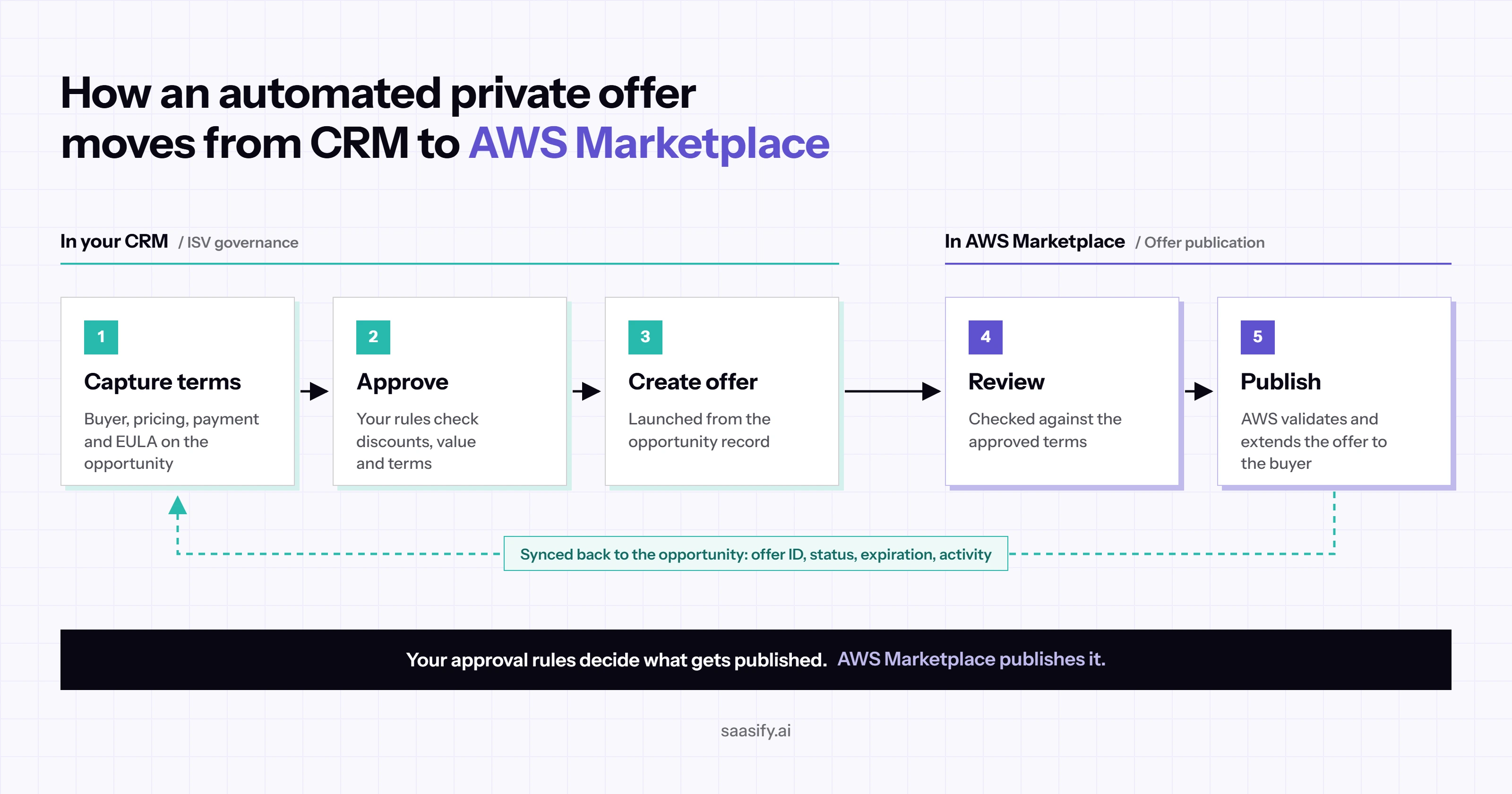
A well-designed private offer workflow starts before anyone opens AWS Marketplace. The commercial terms should already exist in the CRM opportunity and move through a defined approval process before the offer is published.

A typical automated workflow looks like this:

1. Capture the commercial terms in the CRM

The opportunity should hold the information required to build the private offer, including:

  • Buyer AWS account ID

  • Product and plan

  • Contract value and duration

  • Payment schedule and payment terms

  • EULA

  • Offer expiration

  • Channel partner details, where relevant

2. Apply the required approvals

Private offers may require approval based on discount level, contract value, payment structure, EULA changes, or channel economics.

Those approvals should happen before the offer is sent to AWS Marketplace, with the approved values carried into the offer workflow.

3. Create the offer from the opportunity

Once approved, the seller or marketplace team should be able to initiate the AWS Marketplace private offer from the same opportunity record.

The workflow should support the structures AWS now allows, including:

  • New private offers

  • Agreement-based offers

  • Offer Sets

  • Concurrent Agreements

  • Configurable payment terms

  • CPPO workflows

4. Review the Marketplace version before publication

Before the offer goes to the buyer, the final Marketplace record should be checked against what was commercially approved.

That includes the buyer account, pricing, duration, payment schedule, payment terms, expiration date, and legal documents. This final check matters because the Marketplace offer becomes the terms the buyer actually sees and accepts.

5. Publish and sync the result back to the CRM

Once the offer is submitted, AWS validates the publishing request before extending it to the buyer. The offer ID, publication status, expiration date, and subsequent Marketplace activity should then flow back to the CRM opportunity.

The important distinction is that AWS Marketplace handles offer creation and publication; the ISV still needs governance around what is allowed to be published. Automation works best when those approval rules and Marketplace mechanics are treated as one connected workflow.

How to manage AWS Marketplace private offers after they're sent

Offer creation is only the first part of the workflow. Once the offer has been published, teams still need visibility into whether it was accepted, which agreement was created, when payments are due, and when the next commercial action is required.

Private offer management should therefore sync key marketplace events back to the CRM, including:

  • Offer status and expiration

  • Buyer acceptance

  • Agreement status

  • Payment schedules and payment status

  • Billing and usage data relevant to the customer

  • Renewal and expiration dates

  • Replacement, amendment, or expansion offers

This becomes particularly important with Concurrent Agreements because the same buyer account may have multiple active agreements for the same SaaS product. Each agreement needs to remain connected to the right commercial context.

Billing and usage visibility also matters beyond finance. If account teams can see an approaching expiration alongside the customer's marketplace activity and usage, they can start renewal, expansion, or mid-contract conversations with the relevant context already in the CRM.

What is CPPO and how to automate it

Channel Partner Private Offers, or CPPO, involve three parties: the ISV, the channel partner, and the buyer.

Here is how the flow works:

  • The ISV grants the channel partner a resale authorization

  • The channel partner extends its own private offer to the buyer, with its own pricing

  • AWS Marketplace processes the transaction and splits the revenue between the ISV and the partner based on the agreed terms

The operational challenge is attribution. The resale authorization, partner-created offer, buyer transaction, and resulting revenue all need to remain connected to the same underlying opportunity.

CPPO automation should therefore preserve that relationship end to end:

  • Creating and sending the resale authorization

  • Defining the pricing and payment-term boundaries available to the partner

  • Tracking the partner-created offer and its status

  • Linking the completed marketplace transaction back to the partner and CRM opportunity

With those records connected, teams can report on channel-sourced marketplace revenue without rebuilding the transaction history after the deal closes.

The commercial opportunity can be significant. In a Forrester Consulting study cited by AWS, channel partners reported 4–5× larger deal sizes when reselling third-party software through Channel Partner Private Offers.

Signs your AWS Marketplace private offer automation is working

A private offer automation program should improve both deal velocity and operational visibility. Five useful measures are:

  • Offer turnaround time: Time between final commercial approval and the offer being available to the buyer

  • Manual touchpoints per offer: Number of times information has to be re-entered or transferred between systems

  • CRM coverage: Percentage of live private offers and agreements whose current status is visible directly from the CRM

  • Renewal visibility: Percentage of upcoming expirations identified before the account team begins renewal planning

  • CPPO attribution: Percentage of channel transactions that remain linked to the relevant partner and original opportunity

Measure these over time rather than treating automation as complete once offer creation moves into the CRM.

How SaaSify automates AWS Marketplace private offers

SaaSify connects AWS Marketplace workflows to the systems revenue teams already use, so private offers can be created, tracked, and managed without moving the deal into a separate operational process.

Private offers inside Salesforce and HubSpot

SaaSify supports private offer creation and management directly inside the CRM that ISVs use, including, Salesforce, and HubSpot. We built this range because revenue teams no longer all live in Salesforce, and a platform that only supports one CRM leaves too many teams out.

Sellers can use the commercial data already captured on the opportunity to initiate the offer and track its progress through buyer acceptance from the same deal record.

CPPO automation

For CPPO, SaaSify connects the resale authorization, partner-extended offer, marketplace transaction, and revenue attribution back to the original Salesforce opportunity.

This gives channel teams one record for the three-party transaction rather than reconciling the ISV, partner, and buyer activity separately.

Support for newer AWS Marketplace workflows

SaaSify supports Concurrent Agreements across its web portal, Salesforce, and HubSpot, allowing multiple agreements for the same product and buyer account to be tracked independently.

Private offer workflows are also being extended as AWS introduces additional structures and commercial controls across Marketplace.

AI agents and marketplace data access

SaaSify is also adding AI-led workflows around marketplace operations. AI agents in CRM can support tasks with:

  • The Pipeline Insights and Reports Agent builds any AWS pipeline report in plain English, and can deliver it as Excel, PowerPoint, or Word, on a schedule if you want, potentially bringing down 90 to 120 minutes of manual work to under five minutes.

  • The Deal Funding Helper Agent checks an AWS funding request tied to a private offer against AWS's own requirements before it is submitted, flags anything missing or incorrect, and returns a corrected draft.

  • The Sales Play Generator Agent builds a tailored sales play for a specific AWS opportunity, using live Partner Central data along with your CRM's deal context, so prep for a joint AWS call takes minutes instead of a full afternoon.

The SaaSify MCP Connector

The SaaSify MCP Connector brings marketplace data into AI tools like Claude Desktop, through the Model Context Protocol standard. Your team can ask about a private offer's status, which subscriptions are expiring soon, or revenue by cloud provider, in plain English, without opening a separate portal. Right now this covers read access to private offers, subscriptions, cloud providers, and marketplace revenue.

Want to see how this works on one of your AWS private offers?

Bring a live opportunity and the SaaSify team will map how it would run through connected CRM and AWS Marketplace workflows, including direct private offers, CPPO, agreement tracking, and relevant AI workflows.

→ Register for a private offer session

Frequently asked questions

Can you automate AWS Marketplace private offer creation from a CRM?

Yes. With tools like SaaSify, ISVs can create and manage AWS Marketplace private offers directly from their CRM like Salesforce, HubSpot, Zoho CRM and Pipedrive, using deal data already captured on the opportunity.

What is the difference between an MPPO and a CPPO?

An MPPO (Marketplace Private Offer) is a private offer the ISV sends directly to a buyer. A CPPO (Channel Partner Private Offer) is a private offer a channel partner sends to a buyer, using a resale authorization the ISV granted. Both need automation, and CPPO specifically needs end-to-end attribution, since the three-party flow makes revenue easy to lose track of.

What happens if an AWS Marketplace private offer expires before the buyer accepts it?

The buyer can no longer accept the offer after its expiration date. The seller can either extend the expiration date or create a new private offer.

Can you change an AWS Marketplace private offer after it has been sent?

If the offer has not yet been accepted, sellers can update certain offer details or issue a new offer. For an existing SaaS agreement, sellers can use an agreement-based offer to change pricing, entitlements, payment schedules, or contract terms.

Why can't a buyer see or accept an AWS Marketplace private offer?

Common reasons include the buyer being signed into the wrong AWS account, the offer having expired, or restrictions in the buyer's private marketplace. The offer must also be extended to the correct buyer account.

Can an existing AWS Marketplace customer receive a new private offer?

Yes. For supported SaaS products, sellers can create an agreement-based offer to renew, upgrade, or modify an existing agreement. When the buyer accepts it, the new agreement terms take effect and replace the relevant terms of the previous agreement.

When is a buyer charged for an AWS Marketplace private offer?

It depends on the payment structure. Some offers are invoiced when the buyer accepts them, while others use a negotiated flexible payment schedule with invoices issued on specified dates.

Can an AWS Marketplace private offer be cancelled after it is accepted?

Yes, but the process changes after acceptance. An unaccepted offer can be cancelled by the seller directly. Once the buyer has subscribed, the seller of record needs to submit a cancellation request through AWS.

What are the most common mistakes when automating AWS Marketplace private offers?

The biggest mistake is automating offer creation without automating the controls around it. Commercial approvals should happen before publication, approved terms should match what is sent to AWS Marketplace, and offer and agreement data should continue syncing after the buyer accepts.

When should an ISV automate AWS Marketplace private offers?

Automation becomes useful when private offers start creating repeated handoffs between sales, marketplace operations, finance, legal, or channel teams. Common signs include re-entering CRM data into AWS Marketplace, manually checking offer or agreement status, tracking renewals in spreadsheets, or reconciling CPPO transactions after the deal closes. The trigger is less about a specific number of offers and more about how much manual coordination each deal requires.

What does AWS charge for Marketplace private offers?

AWS Marketplace private-offer fees vary by total contract value. The current fee is 3% for private offers below $1 million, 2% for deals from $1 million to under $10 million, and 1.5% for deals of $10 million or more. Renewals are charged at 1.5%. CPPO transactions carry an additional 0.5% fee.

Grow your partnership revenue

See how SaaSify pairs an agentic Cloud GTM platform with hyperscaler experts to multiply your partnership revenue.