Everything you need to know about the AWS Partner Central migration
01. What is the AWS Partner Central migration?
The AWS Partner Central migration is the transition of the AWS Partner Central portal into the AWS Management Console. Announced by AWS in November 2025, it consolidates all partner tools — including ACE co-sell, AWS Marketplace management, funding dashboards, and program management into a single, IAM-governed environment. Every member of the AWS Partner Network (APN) is required to complete this migration. The legacy portal is scheduled to shut down permanently on June 30, 2026.
02. Who does the AWS Partner Central migration apply to?
The migration applies to every organization enrolled in the AWS Partner Network: ISVs, consulting partners, managed service providers, resellers, and distributors. Any organization that currently uses AWS Partner Central to manage ACE opportunities, co-sell activity, Marketplace listings, or partner program benefits must complete the migration before June 30, 2026. There are no exemptions based on partner tier, geography, or company size.
03. Why is AWS migrating Partner Central into the Management Console?
AWS's primary goals are to unify the partner experience with the same infrastructure AWS customers and internal teams use, improve security through IAM-governed access, and reduce the operational silos created by having partner tools in a separate environment from Marketplace and other AWS services. The practical effect is that PSMs, AWS field sellers, and ISV alliances teams all now work from the same console, which removes friction from co-sell collaboration and gives AWS's AI systems (including Amazon Q) a unified data layer to generate partner insights from.
04. What is the deadline for completing the AWS Partner Central migration?
AWS has set June 30, 2026 as the hard deadline. After that date, partners who have not completed the migration will lose access to ACE opportunity submission, co-sell engagements, reseller relationship approvals, and Marketplace solution metadata. AWS has not indicated any intention to extend this deadline, and partners should not plan around an extension. The migration window opened in November 2025, giving partners approximately eight months to complete the process.
05. What does the AWS Partner Central migration actually involve, step by step?
The migration involves five core steps: (1) linking your existing APN account to your AWS Management Console account through business verification; (2) mapping all legacy Partner Central user roles to the new AWS IAM managed policies – this is the most technically complex step, as legacy roles don't translate one-to-one to IAM policies; (3) onboarding all partner users through AWS IAM Identity Center, either directly or through a federated external identity provider such as Okta or Azure AD; (4) migrating solution associations from the legacy catalog into AWS Marketplace; and (5) validating that all ACE opportunities, co-sell workflows, and channel operations are fully intact in the new environment before going live.
06. What is the difference between the AWS Partner Central migration and the S3-to-Partner Central API migration?
These are two separate activities that are frequently confused. The Partner Central portal migration moves your team's interface from the legacy standalone portal into the AWS Management Console, it affects login, user access, and how ACE and Marketplace are navigated. The S3-to-Partner Central API migration (completed by AWS in 2024) changed how data flows between Partner Central and CRM systems like Salesforce, replacing the legacy S3-based file exchange with a direct REST API. Completing one does not complete the other. ISVs who updated their CRM integration to the V2 API in 2024 still need to complete the portal migration before June 2026.
07. How much does the AWS Partner Central migration cost?
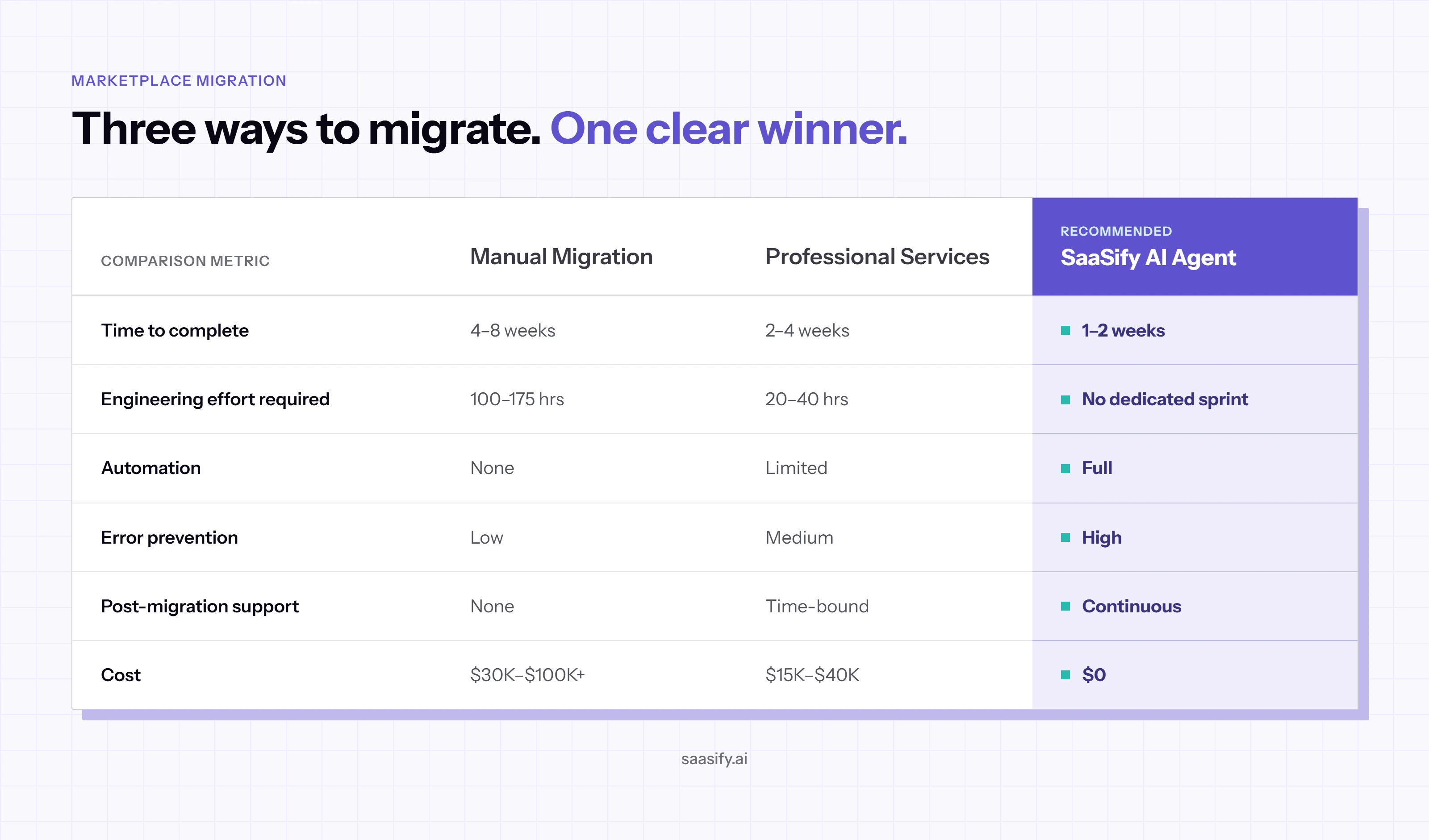
AWS does not charge for the migration itself. The cost is in engineering time. A self-managed migration for a mid-sized ISV typically requires 4–8 weeks of engineering capacity, covering IAM mapping, account linking, user onboarding, solution migration, and post-migration validation. At fully loaded developer costs, that translates to $30,000–$100,000 in redirected engineering investment, with additional post-migration validation and troubleshooting cost. SaaSify's AI Migration Agent completes the full migration at zero cost, preserving that engineering capacity for product and growth work.
08. How does SaaSify's AI Migration Agent work, and what does it actually do?
SaaSify's AI Migration Agent manages the full Partner Central migration on your behalf. Before any changes are made, the agent audits your existing configuration, user roles, ACE pipeline state, Marketplace listings, and solution associations, to build a complete picture of what needs to move. It then maps legacy Partner Central roles to the correct IAM managed policies using AWS-defined translation rules, executes account linking and business verification, onboards users at scale, migrates solution associations to Marketplace, and validates that all co-sell workflows, ACE opportunities, and Marketplace integrations are intact before go-live. The process takes days, not weeks, and requires zero engineering effort from your team.
09. Is SaaSify's migration agent really free? What's the business model?
The migration agent is genuinely free, no contract required to start, no migration fee, and no obligation to purchase any SaaSify product afterward. ISVs who migrate and want their ongoing marketplace and co-sell operations automated choose to continue with SaaSify. Those who don't are under no obligation. There is no lock-in, no hidden tier, and nothing embedded in the process that requires a paid subscription.
10. What is the single most important thing an ISV can do post-migration to turn it into a revenue event?
Establish real-time CRM-to-Partner Central pipeline sync before your first post-migration PSM meeting. The unified console gives PSMs better access to your pipeline — but only if that data is current. An ACE pipeline that updates in near real time from your CRM is the strongest signal to AWS field teams that you are a high-trust, high-responsiveness co-sell partner. AWS's internal recommendation engine, which influences how PSMs prioritize partner opportunities, weighs pipeline recency and partner responsiveness. The migration gets you into the right environment. Real-time sync is what makes AWS field sellers choose to co-sell with you first.
The migration is mandatory.
The only variable is what you give up to get there, and whether your team arrives ready to grow, or still catching up from the transition.
Start Your Free Migration →
Already live on the new Partner Central? Book a 30-minute demo to connect your CRM and automate your co-sell operations from day one.