Cloud marketplace sales have been growing exponentially over the past few years, and Google Cloud Marketplace is in direct sync with that curve.
From 10% market share in Q2 2022 to 14% by Q1 2026, Google Cloud posted a striking 82% year-on-year revenue growth in Q2 2026. Committed spend on Google Cloud scaled from around $74 billion in early 2024 to $462 billion in early 2026, and the platform is still far less crowded.
Together, that signals massive revenue potential for any ISV that decides to list SaaS offer on Google Cloud Marketplace and sell to enterprise buyers at scale. This blog guides you through the first stage of that journey, listing a SaaS offer on Google Cloud Marketplace. It also reveals how choosing SaaSify as your Google Cloud marketplace listing service provider can cut the time between listing and real revenue.
TL;DR
- Listing SaaS offer on Google Cloud Marketplace gives you the opportunity to sell directly to cloud-first enterprise buyers.
- Deals on GCP are bigger in size and close faster due to pre-committed budgets and joint selling with field sellers.
- Prerequisites to sell on Google Cloud Marketplace include becoming a vendor, completing the onboarding validation form, meeting product-specific requirements, setting up a pricing structure, and integrating your product with Google Cloud.
- Multiple actions are required at each stage of the GCP listing. API integrations demand engineering bandwidth; document review and submission consume time and resources. On average, a DIY ISV takes between three and six months to go live on GCP.
- SaaSify cloud GTM platform helps ISVs sell on GCP in as less as two weeks, leveraging automation and pre-configured integration set up. It accelerates revenue growth by streamlining the entire co-sell workflow, automating operations, and providing a unified platform for multi-cloud SaaS offer lifecycle management and tracking.
- This blog guides you through the exact process to list SaaS offer on Google Cloud Marketplace, and the impact of automation on cost-cutting and marketplace revenue acceleration.
Prerequisites to Selling SaaS on Google Cloud Marketplace
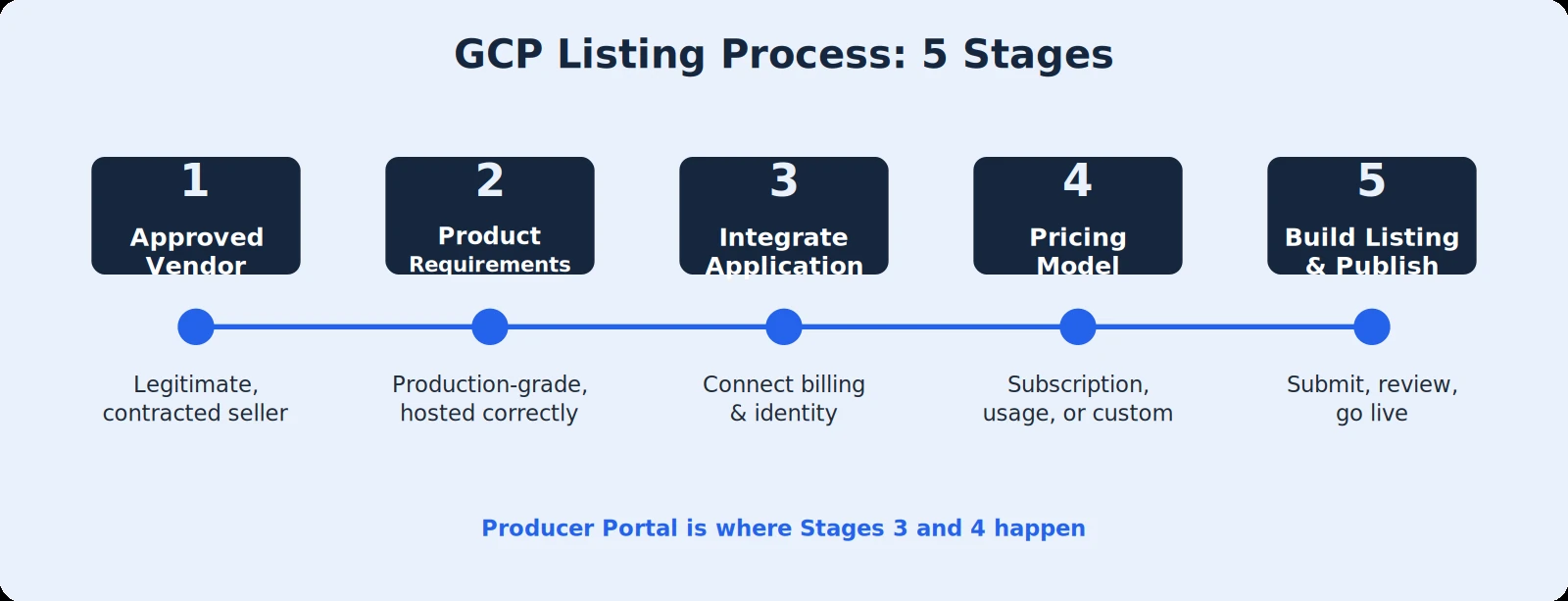
Google Cloud Marketplace listing requirements for SaaS come down to two things: meeting listing requirements and meeting operational requirements. There are five major stages involved in the process:
- Become an approved vendor. Google confirms you are a legitimate, contracted seller.
- Meet the product requirements. Google confirms your product is production-grade and hosted the right way .
- Integrate your application. Your software connects to Google’s billing and identity systems.
- Set your pricing model. Choose subscription, usage-based, or custom pricing and submit it for review.
- Submit for review and publish. Submit product details, pricing, and technical integration for Google’s review, then publish once approved.
How to List SaaS Offer On Google Cloud Marketplace
Here are the five steps to list SaaS offer on Google Cloud Marketplace.
Stage 1: Become an Approved Vendor
To become an approved Google Cloud Marketplace vendor, three things must be true about your company, not your product yet:
- Your organization joins the Google Cloud Partner Network. This is Google’s official program for companies that build on or sell through Google Cloud. You enroll your organization through the Partner Network Hub.
- Your company is incorporated in a supported region. Google pays vendors only in certain countries. If the legal entity doing the selling is incorporated somewhere Google does not support for payments, that is a blocker to resolve before anything else.
- You set up a vendor account and a payment profile. The vendor account is your seller identity inside Google’s marketplace system. The payment profile is how Google pays you: bank details, tax information, and the legal entity that receives funds. Google requires both to be in good standing, meaning complete and valid.
Once those are in place, two forms unlock the actual tools:
- The Cloud Marketplace Onboarding Validation Form, which Google requires when you list SaaS offer on Google Cloud Marketplace for the first time, every listing after it.
- The Cloud Marketplace Project Info Form, which grants access to Producer Portal. Google’s Marketplace team provides this form to you.
Producer Portal is the term to remember. It is the web console where all real listing work happens in Stages 3 and 4. You cannot enter it until the Project Info Form is complete. No form, no portal, no listing.
Stage 2: Meet the Product Requirements
Google’s listing requirements name three conditions:
- Production-ready. A live, real product. Experimental products cannot be publicly listed.
- Enterprise-ready. Google defines this concretely as a professional online presence, a defined sales motion, customer support, and adherence to strong security best practices.
- Clean and safe. No known vulnerabilities, viruses, spyware, or malicious code of any kind.
Two more product requirements are stated directly by Google and are worth knowing early:
- Feature parity. Your Marketplace version must have the same capabilities and features as the version you sell anywhere else. No stripped-down “marketplace edition.”
- Meaningful consumption. Your listing must result in real Google Cloud consumption by the customer who buys or uses it.
Stage 3: Integrate Your Application
This is the first genuinely technical stage. Here your product stops being a passive listing and connects to Google’s systems. Before writing code, your team needs one thing from Google: a Partner Engineer, the Google-side technical contact assigned to your onboarding, must enable access to the Cloud Commerce Partner Procurement API. This is a real dependency with another team’s name on it, so request it early.
In Google’s own description, the integration involves modifying the frontend and backend of your software to do three things:
- Create accounts for users. When someone buys through the Marketplace, your system provisions their account automatically. No manual onboarding.
- Link accounts to Google identities. Each account ties to the buyer’s Google account, establishing the connection between who bought it on Google and who they are in your app.
- Let users sign in with Google credentials. Buyers log into your app using their Google login rather than a separate username and password.
Stage 4: Set Your Pricing Model
Before you build the public listing, you decide how customers pay. Google reviews your pricing model on its own, so setting it up is a distinct stage rather than a detail buried in the storefront. You configure pricing in Producer Portal and choose one of three models:
- Subscription
- Usage-based
- Custom
Stage 5: Build the Listing and Pass Review
Now the visible storefront, and Google gives a specific order with real timing.
- Set up the product in Producer Portal so it can be distributed and displayed.
- Choose your pricing model. You select how you charge: subscription, usage-based, or custom.
- Build the store listing. This is your description, assets, screenshots, and your End User License Agreement, the legal terms buyers accept when they purchase.
- Submit for review. You submit the separate parts of your product — product details, pricing, and technical integration — and Google’s Cloud Marketplace team reviews each one, working with you to resolve issues before approving.
- Publish. Once every submission is approved, you publish, and the product goes live within minutes.
Where Do ISVs Face Challenges in the GCP Marketplace Listing Process?
The GCP marketplace listing requirements for SaaS involve multiple steps. While some steps are non-technical, there are many dependencies involved. For instance, Stage 1 is slow not because it is hard, but because it is bureaucratic and depends on other people: legal for the entity and contracts, finance for the payment profile and tax setup, and Google’s own team for the forms.
The technical integrations, on the other hand, demand engineering bandwidth as well as collaboration with a Google engineer. This is the stage that stretches timelines and utilizes resources heavily. The Partner Engineer dependency, the account-and-entitlement lifecycle, and the identity-linking flow are where most of the work lives.
How SaaSify Enables Live GCP Status in Two Weeks
Among GCP marketplace listing service providers, SaaSify leverages its pre-built setup and configured templates to move things at scale. Here is how each step is completed when you list a SaaS offer on Google Cloud Marketplace with SaaSify.
1. Partner Onboarding
To get started, an ISV must join the Google Cloud Partner Advantage Program and sign the Google Marketplace Vendor Agreement, which governs how you transact on the platform. This includes:
- Accepting Google’s terms for monetization.
- Setting up your partner portal.
- Defining your company-level metadata.
SaaSify experts guide you through partner registration with pre-validated templates and best practices, including the documentation that you need to submit to Google.
2. Configuring Your SaaS Product for the Marketplace
This is where most ISVs start feeling the pressure. Google Cloud expects detailed product metadata, pricing models, UI assets, documentation, and integration configurations.
You will need to define:
- SaaS pricing (flat-rate, usage-based, tiered).
- Technical integration type (SaaS with customer-provisioned resources, managed service, and so on).
SaaSify understands that as a beginner, our partners may not be familiar with pricing structures or the best subscription models to drive initial sales. Our experts guide you with templates that best suit your SaaS offers and business objectives. They also guide you through configuring everything via an intuitive, no-code dashboard, including metadata that optimizes your SaaS offers for enhanced visibility and increased engagement.
3. Integrating Your Offer with Google Cloud Marketplace
One of the most technically demanding steps is integrating with Google’s Cloud API to enable marketplace approval and go live for deployment. While this can be a time-consuming and resource-intensive job for ISVs, demanding expertise in coding and integrations, SaaSify simplifies the entire API integration workflow through pre-configured templates, cutting your deployment time to days instead of months.
Beyond Listing: Transact, Optimize, and Grow with SaaSify
Your partnership with SaaSify extends beyond listing. The next crucial step is ensuring marketplace success through automation and on-demand expert advisory, and the ability to boost revenue operations at scale. While our experts guide you through the initial stages, we remain available for strategic training and on-demand advisory services, enhancing your teams’ efficiency to ensure long-term marketplace success. With the SaaSify cloud GTM platform, you can:
- Publish private offers to enterprise customers directly from the dashboard.
- Track buyer lifecycle metrics and usage patterns.
- Enable co-sell workflows with Google Cloud’s field teams.
- Customize pricing plans with discounts, seat-based billing, and free trials.
Key Benefits for ISVs Selling on Google Cloud Marketplace
Selling on Google Cloud Marketplace gives ISVs a strategic edge, helping them expand their global base, enhance sales, and capitalize on incentives to maximize their gains. Let us take a brief look at some of the key benefits for ISVs below.
Access to Google’s Global Customer Base
Global audience reach and AI-powered recommendations for your SaaS offer make Google Cloud Marketplace a strategic and effective partner sales channel. Besides boosting your short-term gains, Google Cloud Marketplace can be strategically used to develop and build brand awareness on a global scale. The GCP Marketplace connects your offer with thousands of enterprise buyers across various industries. Many of them have pre-committed budgets for third-party solution purchases. By listing your solution here, you put your software in front of a pre-qualified, cloud-savvy audience whose budget, urgency, and technical needs align with your offering.
Accelerated Deal Cycles via Pre-Approved Procurement
One of the major hurdles in enterprise software sales is the procurement process. Google Cloud Marketplace helps eliminate this obstacle by allowing buyers to purchase software directly through their existing Google Cloud agreements. This means:
- No need for new vendor onboarding.
- SaaS spending counts toward Google Cloud’s committed use.
- Legal and billing processes are already streamlined.
Unified Billing and Subscription Management
ISVs enjoy simplified billing since Google handles invoicing, collections, and remittances. Buyers receive a single, consolidated invoice from Google Cloud that includes both SaaS purchases and infrastructure costs. This billing integration is especially beneficial for usage-based pricing models: Google manages the metering and dynamically bills customers based on their usage, allowing you to focus your internal resources elsewhere.
Growth-Led Empowerment and Co-Sell Opportunities
Google Cloud Marketplace offers tools, insights, and programs to help ISVs scale in multiple dimensions. ISVs can study buyer behavior through insights and build tailored strategies to benefit from current and upcoming trends and cyclical sales opportunities.
One of the standout benefits of the Google Cloud Partner Advantage program is the opportunity to co-sell alongside Google’s extensive global sales team. When you co-sell, your SaaS offering can be:
- Recommended by partner sellers to buyers where your solution is a suitable fit.
- Included in multi-million-dollar enterprise deals alongside other sellers’ offerings to solve specific buyer needs.
Google actively encourages its sellers to incorporate ISV solutions into their deals, which means they have a real incentive to introduce your product to the right clients.
Eligibility for Strategic Programs and Incentives
Selling on the GCP Marketplace opens up a range of ecosystem benefits, including:
- Marketplace Incentive Program (MIP): Earn credits and marketing development funds (MDF) based on your revenue transactions. Google uses MDF incentives to collaborate with partners to drive sales and build awareness within the Google Cloud ecosystem.
- Partner Engineering Support: Get expert advice on optimizing your listing, deployment architecture, and go-to-market strategies.
- Multiparty Private Offers (MPOs): Provide flexible pricing and contracting options for customers and partners in large deals, enabling ISVs to offer their best deals and secure long-term revenue recognition.
These programs are crafted not just to help you get listed, but to support your growth and scaling efforts.
Conclusion
Among the leading hyperscalers, Google Cloud Marketplace has carved out a powerful position, not only as a distribution platform but as a co-sell engine that fuels growth, accelerates enterprise adoption, and simplifies procurement for cloud-native buyers.
However, many ISVs still grapple with a pressing challenge: how to list SaaS offer on Google Cloud Marketplace efficiently, accurately, and in a way that sets the stage for long-term success. Manual onboarding methods, complex API integrations, rigid billing models, and partner portal intricacies often slow down this journey and strain lean go-to-market teams.
That is precisely where SaaSify cloud GTM platform is transforming the process.
With its no-code cloud GTM framework, SaaSify eliminates the need for extensive engineering support and enables product teams to own the entire listing lifecycle, from offer creation and API fulfilment to billing, identity management, and co-sell activation. The platform empowers ISVs to go from “listing ready” to “live and transactable” in a matter of days, while ensuring every touchpoint aligns with Google’s marketplace standards.
Whether you are planning your first listing or looking to list on cloud marketplaces across several clouds, adopting a smart GTM platform like SaaSify can turn your listing into a growth lever, not just a checkbox. It is also the clearest answer to how to use Google Cloud Marketplace for sales that compound over time.
Are you ready to simplify your path to list SaaS offer on Google Cloud Marketplace successfully?
Frequently Asked Questions
What is required to list SaaS offer on Google Cloud Marketplace?
You need three things: an organization enrolled in the Google Cloud Partner Network with a vendor account and payment profile; a product that is production-ready, enterprise-ready, and hosted as per patterns provided by Google, and a technical integration with Google’s Procurement API for account creation, Google sign-in, and usage reporting.
How long does GCP Marketplace approval take?
Getting approval from Google for active marketplace selling depends on the speed and accuracy of the steps of fulfilment. SaaSify enables live GCP selling in two weeks.
Can I sell a SaaS product without a VM on Google Cloud Marketplace?
Yes. SaaS is a distinct listing type, billed by Google, where your product stays hosted and managed by you and only integrates with Google for billing, identity, and procurement. Unlike VM or Kubernetes listings, nothing deploys into the buyer’s environment, and no virtual machine image is required. SaaS is the recommended starting point for most ISVs because it has the simplest integration path.
How do sales teams use Google Cloud Marketplace listings?
Sales teams use listings as a co-sell and procurement tool. Because buyers can purchase against their committed Google Cloud spend, deals face less procurement friction. Teams issue private offers with custom pricing and terms to specific customers, and can co-sell alongside Google’s field sellers, who have incentive to bring ISV solutions into their enterprise deals.
What is the difference between public and private listings on GCP?
A public listing is visible to all Google Cloud customers at standard pricing; a private offer is a custom deal (pricing, terms, duration) extended to a specific customer and visible only to them.
Do I need a Google Cloud account to list my SaaS?
You need a partner/vendor account, not a customer billing account, to publish. You enroll your organization in the Google Cloud Partner Network and operate through Producer Portal. Your buyers use their own Google Cloud customer accounts to purchase. Since SaaS listings must be primarily hosted on Google Cloud, you will also use Google Cloud as an infrastructure customer, but that is separate from the partner account that lets you list.