
AWS Marketplace for Startups: How to Get Listed and Sell

By Amit MalikOct 16, 2026 · 11 min read

TL;DR

  • For Startups, getting started on AWS Marketplace requires an AWS account, seller registration, tax and banking details, a customer-ready product, and a supported pricing model.

  • The process involves completing the required integration, publishing a transactable listing, and selling through public and private offers.

  • A transactable listing is the starting point, enabling you to sell and draw down committed spend, but it doesn’t give you access to AWS referrals or incentivized co-sell. For those, startups on the Software Path must clear the Foundational Technical Review (FTR) and ACE eligibility.

  • AWS charges no upfront or monthly listing fee. You pay a transaction fee only when you sell. For SaaS, it’s 3% on public offers and private offers under $1M. Larger private offers pay 2% or 1.5%, and renewals pay 1.5%.

  • AWS funding programs such as the Private Offer Promotion Program (MPOPP) and proof of concept (POC) funding help startups close early deals by lowering the buyer’s cost. If your customer has a pre-committed AWS budget to draw down, your deal stops competing for new budget.

  • The AWS Marketplace List & Sell Incentive offsets the cost of listing your first product, expanding to a new country, or enabling Buy with AWS.

  • Despite a clear path to market, listing, selling, and scaling on AWS Marketplace can be resource-intensive for startups. It takes technical expertise and in-house capabilities to compete with established sellers.

  • SaaSify’s agentic platform simplifies offer lifecycle management for startups on AWS Marketplace. It combines AI agents, automated workflows, and hyperscaler expertise to help you launch offers in days instead of months. Our AI agents handle listing, private offers, co-selling, funding requests, and reporting, so your sales and revops stay on revenue acceleration.
AWS Marketplace for Startups: How to Get Listed and Sell

For an early-stage software startup, finding enterprise customers is only half the challenge. The other half is getting through procurement, establishing buyer confidence, and converting interest into paid contracts without stretching a small team too thin.

AWS Marketplace lets startups sell software to AWS customers through a purchasing process those customers already use, with subscription, contract, or usage-based pricing. Getting results takes more than a listing: you need preparation before you publish and a sales plan after.

This guide to AWS Marketplace for startups covers who should sell, what it takes to qualify, what it costs, how to publish your first listing, how co-selling with AWS works, and which AWS funding programs can help you close early deals.

Is AWS Marketplace Right for Early-Stage Startups?

Yes, if you meet the seller and product requirements. AWS’s seller requirements focus on account standing, tax and banking details, and product readiness, not company age. What a startup does need is the capacity to support customers, maintain the product, and manage marketplace transactions.

AWS Marketplace fits best for startups selling B2B software to enterprises that already run on AWS. For startups, that creates several potential advantages:

  • Spend against existing AWS commitments: Many enterprise buyers can apply marketplace purchases toward their AWS spending commitments, which turns “do we have budget?” into “which budget does this come from?”

  • A familiar purchasing process: Buyers accept terms and pay through their AWS bill instead of onboarding a new vendor.

  • Simpler billing and collection: AWS handles marketplace billing and collection. You remain responsible for the product, the customer relationship, and your contractual obligations.

  • A path to co-selling with AWS: A transactable listing is the starting point for working opportunities alongside AWS sellers. The co-sell section in this guide explains what else is required.

  • Access to AWS funding: Marketplace sellers can apply for AWS programs that offset listing costs and lower the buyer’s price on private offers. The funding section below covers each one.

None of these benefits guarantee discovery or referrals. A listing gives buyers another way to purchase your software. Demand generation, sales execution, product fit, and partner engagement decide whether that turns into revenue.

When should a startup consider AWS Marketplace?

AWS Marketplace is worth evaluating if your startup has a production-ready B2B product, a defined target customer, and a sales pipeline that includes AWS customers. It is a weaker fit if your product is still a prototype, your team cannot support paying customers, or your buyers have little reason to purchase through AWS.

Before committing resources, answer three questions:

  1. Do your target customers already use AWS and have a reason to buy through its marketplace?

  2. Can your team support the technical and commercial requirements of a marketplace listing?

  3. Do you have a plan to generate demand and convert prospects after publication?

If the answers are yes, AWS Marketplace can become a useful sales channel and part of your wider cloud GTM strategy as your startup grows.

Eligibility and Requirements for AWS Marketplace Startups

Startups can register if they meet the requirements for their location, product type, and commercial model.

The following list is a practical starting point for a SaaS startup.

1. An AWS account and seller registration

You need an AWS account in good standing and must complete AWS Marketplace seller registration before you publish. Use an account dedicated to marketplace selling and manage access through IAM permissions. Name one person to accept the AWS Marketplace Seller Terms and own the AWS relationship.

2. A production-ready software product

Your software must meet AWS Marketplace product guidelines. For SaaS, that includes appropriate security controls, customer onboarding, product documentation, and a working subscription or contract experience. The product should be ready for paying customers, with a defined process for resolving support requests and releasing updates.

3. Tax, banking, and business verification

Sellers of paid products must meet the rules for their jurisdiction and provide tax and payment information. Depending on where you are based, VAT registration or additional business verification may apply.

4. A pricing and billing model

Before you build the listing, decide how customers will buy. AWS Marketplace supports three SaaS pricing models: subscriptions, contracts, and contracts with pay-as-you-go charges. Your choice determines the integration work, how buyers are charged, and how your application handles subscriptions and entitlements.

5. Customer support and security processes

You must be ready to maintain the product after it goes live. For SaaS, that means documented customer support, data protection, access controls, and a process for handling security issues. Document how customer data is collected, stored, used, shared, and deleted.

Meeting the listing requirements is the starting point, and a marketplace readiness checklist helps you catch gaps early. The ongoing commitment includes keeping the listing accurate, supporting customers, managing renewals, and tracking transactions.

AWS Marketplace Fees: What It Costs to Sell

AWS charges no upfront or monthly fee to list a product. Instead, it takes a listing fee, calculated as a percentage of the transaction, only when a sale happens.

Offer type

Listing fee

Public SaaS offer

3%

Private offer, total contract value under $1M

3%

Private offer, $1M to under $10M

2%

Private offer, $10M or more

1.5%

Private offer renewal

1.5%

Channel partner private offer (CPPO)

Adds 0.5% to the fee above

Regional fees can apply on top. Check the current AWS Marketplace listing fees before you set pricing.

For most startups, the fee is not the biggest cost. Engineering time for the integration usually is, which is why the next section treats integration as its own step.

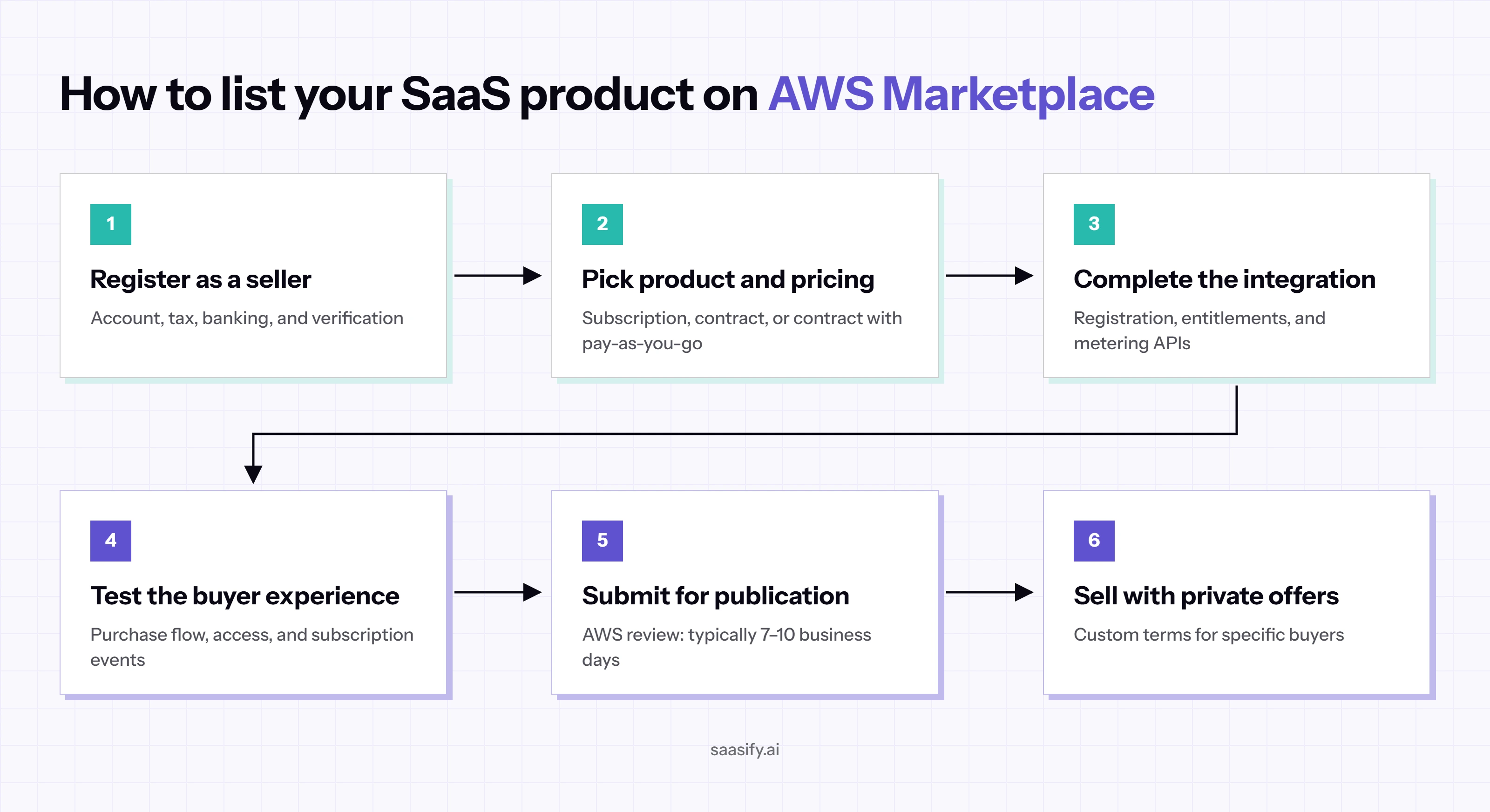
How to List Your SaaS Product on AWS Marketplace: 6 Steps

Publishing your first SaaS listing involves preparing the product, building the billing integration, testing the buyer experience, and submitting the listing for review.

AWS Marketplace for Startups: How to List SaaS Offer

Step 1: Register as an AWS Marketplace seller

Review the seller requirements, register through AWS Marketplace, and complete the tax, banking, and verification steps. Set up account access for the people who will manage the listing.

AWS typically reviews seller registration, tax details, and disbursement method within three to four business days. SaaSify’s seller registration walkthrough covers each screen.

Step 2: Select your product and pricing model

Choose the product you want to publish and the pricing model that matches how you sell: subscription, contract, or contract with pay-as-you-go.

Prepare your pricing dimensions, product description, logo, end-user license agreement (EULA), support information, and customer documentation. Your listing should explain the problem your software solves, who it serves, and what customers receive after they subscribe.

Step 3: Complete the required integration

For SaaS, the integration work can include AWS Marketplace APIs for customer registration, entitlement checks, and usage metering. Your application must respond correctly to purchase and subscription events.

This is usually the most resource-intensive step for a startup without marketplace experience. Estimate the engineering effort before you begin and name an owner for the integration, testing, and ongoing maintenance. If you would rather keep engineers on the product, see how SaaSify automates marketplace listing.

Step 4: Test the listing and purchasing experience

Test the product the way a buyer will experience it. Confirm that the purchase flow works, customers can register and access the software, pricing behaves as expected, and subscription events are handled correctly.

Review the listing content, pricing, documentation, and support details before you submit. Errors caught here prevent delays during review.

Step 5: Submit the product for publication

Submit the product through the AWS Marketplace publishing workflow. For SaaS products, AWS documents a 7–10 business day review before the listing becomes public, and longer if its team finds errors.

Step 6: Start selling with private offers

To land your first marketplace sale, SaaSify recommends that startups focus first on prospects who already use AWS and would benefit from buying through the marketplace.

Most enterprise deals close through private offers: custom pricing and terms you extend to a specific buyer, who accepts them inside AWS Marketplace. Plan your first deals as private offers rather than public subscriptions. This guide walks through how to publish private offers on AWS Marketplace, and once volume grows, private offer automation keeps the process from slowing deals down.

How Startups Get to Co-Sell With AWS

A listing does not automatically bring AWS sellers into your deals. Co-selling runs through the APN Customer Engagements (ACE) program, where partners share opportunities with AWS and receive referrals in return.

To qualify, startups typically need a live, transactable marketplace listing, a completed AWS Foundational Technical Review (FTR), and ACE eligibility through AWS Partner Central. Software companies join through the AWS Partner Network’s Software Path, which is where FTR and ACE eligibility are managed.

Treat the listing as step one of the co-sell path, not the whole path. Teams that automate co-sell from ACE to marketplace revenue keep both sides in sync. Our complete guide to selling on AWS Marketplace covers the full co-sell path, and you can also download SaaSify’s guide to co-selling with AWS ACE.

AWS Marketplace Funding Programs for Startups

AWS also funds parts of the selling process. Three programs are relevant to startups at different stages, and a fourth becomes available once you have co-sell traction.

Program

What it funds

Who benefits

Best stage

AWS Marketplace List & Sell Incentive

Cost of listing through an integrator

You

Before your first listing

Private Offer Promotion Program (MPOPP)

AWS promotional credits on accepted private offers

Your customer

First deals onward

Proof of concept (POC) funding

Credits for partner-led customer proofs of concept

Your customer

Late-stage deals that need a trial

AWS Marketplace List & Sell Incentive

The List & Sell Incentive offsets the cost of listing your solution in AWS Marketplace. It covers your first listing, expanding into a new country, and enabling product-led growth options such as Buy with AWS. You work with an integrator, which you can find through AWS Partner Central.

Private Offer Promotion Program (MPOPP)

MPOPP lowers your buyer’s effective cost without you cutting your price. After a customer accepts your private offer and AWS verifies the transaction, AWS issues promotional credits to the customer’s AWS account, calculated on the deal’s total contract value.

New marketplace sellers get funding support from their first deals, and established sellers get incentives for renewals. You request funding through the AWS Partner Funding Portal, and AWS targets delivery for the next business day after the offer is accepted. Program rates and eligibility are published in the AWS Partner Funding Benefits Guide inside Partner Central.

Proof of concept (POC) funding

When a buyer needs to test your product before committing, AWS can fund customer credits for a partner-led proof of concept. Requests typically go through your AWS Partner Development Manager or the customer’s AWS account manager, so this funding works best on deals where AWS is already engaged.

ISV Accelerate: the next step

ISV Accelerate is AWS’s co-sell program for ISVs. AWS account managers get incentives to co-sell your solution through private offers. It suits later-stage sellers. Eligibility requires:

  • A generally available AWS Marketplace listing

  • ACE eligibility and Validated or Differentiated status in AWS Partner Central

  • At least 5 launched opportunities and 15 qualified ACE opportunities in the past 12 months

  • At least one person who has completed the Co-Selling with AWS learning module

  • At least $2,000 in recognized AWS revenue at enrolment

How SaaSify Helps Startups Get Started

For a small team, the harder work starts after the listing goes live. Engineers lose sprints to integration. Every private offer is rebuilt by hand from CRM data. Co-sell opportunities in ACE drift out of sync with your pipeline. Funding requests get filed late or not at all. Payouts, fees, and taxes need reconciling across separate reports. Building all of that in-house means maintaining marketplace code and processes instead of shipping product.

SaaSify’s agentic platform handles marketplace operations so your team stays on revenue work. AI agents and automated workflows, backed by hyperscaler expertise, cover the full offer lifecycle:

  • Listing and integration: Metering APIs and pre-built integrations that make your product transactable without building the AWS Marketplace integration in-house.

  • Private offers from your CRM: Create and manage private offers, including CPPO, from inside Salesforce.

The result is offers launched in days instead of months, without tying up your engineers.

If AWS Marketplace for startups fits your sales plan, start with a clear product, a defined buyer, and a plan for your first private offers. See how SaaSify’s marketplace automation works, or book a demo with our team.

Frequently asked questions

Is AWS Marketplace for startups worth it?

It is worth it if you have a production-ready B2B product and enterprise prospects who already buy through AWS. It is a weaker fit for prototypes or for buyers with no reason to purchase through AWS. A listing gives buyers an easier way to purchase, but revenue still depends on your sales plan, private offers, and co-sell engagement.

What are the requirements to list as a startup on AWS Marketplace?

You need an AWS account in good standing, completed seller registration, and a product that meets AWS Marketplace product guidelines. Paid sellers must also provide tax, banking, and verification details for their jurisdiction. SaaS products need a working integration for their pricing model, security controls, and customer onboarding.

How much does it cost to list on AWS Marketplace?

There is no upfront or monthly listing charge. AWS takes a listing fee only when a transaction occurs: 3% for public SaaS offers and private offers under $1M, 2% from $1M to under $10M, 1.5% at $10M or more, and 1.5% on private offer renewals. Channel partner private offers add 0.5%, and some regions add a regional fee.

How long does listing take for a new company?

Seller registration review typically takes three to four business days. After you submit a SaaS product, AWS documents a 7–10 business day review before the listing goes public. The full timeline also depends on integration and testing, which usually take longer than either review.

What AWS funding is available to startups selling on AWS Marketplace?

The AWS Marketplace List & Sell Incentive offsets the cost of listing through an integrator. The Private Offer Promotion Program (MPOPP) gives your customer AWS promotional credits on accepted private offers. Proof of concept funding can cover partner-led trials, and ISV Accelerate adds AWS seller incentives once you have co-sell traction. Rates and eligibility are in the AWS Partner Funding Benefits Guide.

Can India-based startups sell to US buyers on AWS Marketplace?

Not as an India-based seller. AWS restricts sellers registered in India to buyers in India. Startups that want to sell to US or European buyers need to register through an entity outside India. Confirm the right structure with a tax advisor before registering.

Do startups need FTR to co-sell with AWS?

Yes. A listing lets you sell, but AWS referrals and incentivized co-sell require a completed Foundational Technical Review and ACE eligibility, managed through the AWS Partner Network’s Software Path.

Can India-based startups sell to US buyers on AWS Marketplace?

Not as an India-based seller. AWS restricts sellers registered in India to buyers in India. Startups that want to sell to US or European buyers need to register through an entity outside India. Confirm the right structure with a tax advisor before registering.

Grow your partnership revenue

See how SaaSify pairs an agentic Cloud GTM platform with hyperscaler experts to multiply your partnership revenue.