



Microsoft’s Q4 FY26 earnings call revealed remaining performance obligations (RPO) grew to $678 billion, up 84% year over year. Microsoft expects 30% of that, around $203 billion, to convert to revenue in the next twelve months. If even 30% of that near-term revenue routes through co-sell, that’s over $60 billion in demand ISVs don’t have to generate. They just have to be positioned to catch it. That’s what co-selling on Microsoft Azure Marketplace actually unlocks, and this guide is built to show you how to get there.
TL;DR
Co-selling on Microsoft Azure Marketplace lets ISVs close deals together with Microsoft’s field sellers, reaching MACC-backed enterprise buyers and closing larger deals than an ISV could reach selling alone. It is one of the clearest ways to sell SaaS to enterprise buyers at scale.
To qualify for co-selling on Microsoft Azure Marketplace, you move through four co-sell statuses: In-Market, Co-sell Ready, Co-sell Eligible, and Azure IP Co-sell Eligible. You get there by joining the Microsoft AI Cloud Partner Program, publishing a transactable listing so you can sell on Microsoft Marketplace, and meeting Microsoft’s validation and revenue requirements.
The payoff is real. The operational load is where most ISVs stall: Partner Center work, CRM sync, and referral response all pile up fast. This guide walks through who benefits, the eligibility tiers, the step-by-step process, how to work with Microsoft reps, the mistakes to avoid, and how to measure co-selling success.
It also reveals how top ISVs use the SaaSify cloud GTM platform to automate the repetitive marketplace operations and fuel revenue growth with specialized AI agents for each stage of their Microsoft marketplace GTM motion.
What is Co-selling on Microsoft Azure Marketplace
Co-selling on Microsoft Azure Marketplace is a joint sales motion where an ISV and Microsoft’s field sellers pursue the same customer opportunity together, sharing referrals through Microsoft Partner Center to close deals faster. ISVs qualify by joining the Microsoft AI Cloud Partner Program, publishing a transactable listing, and meeting Microsoft’s co-sell status requirements.
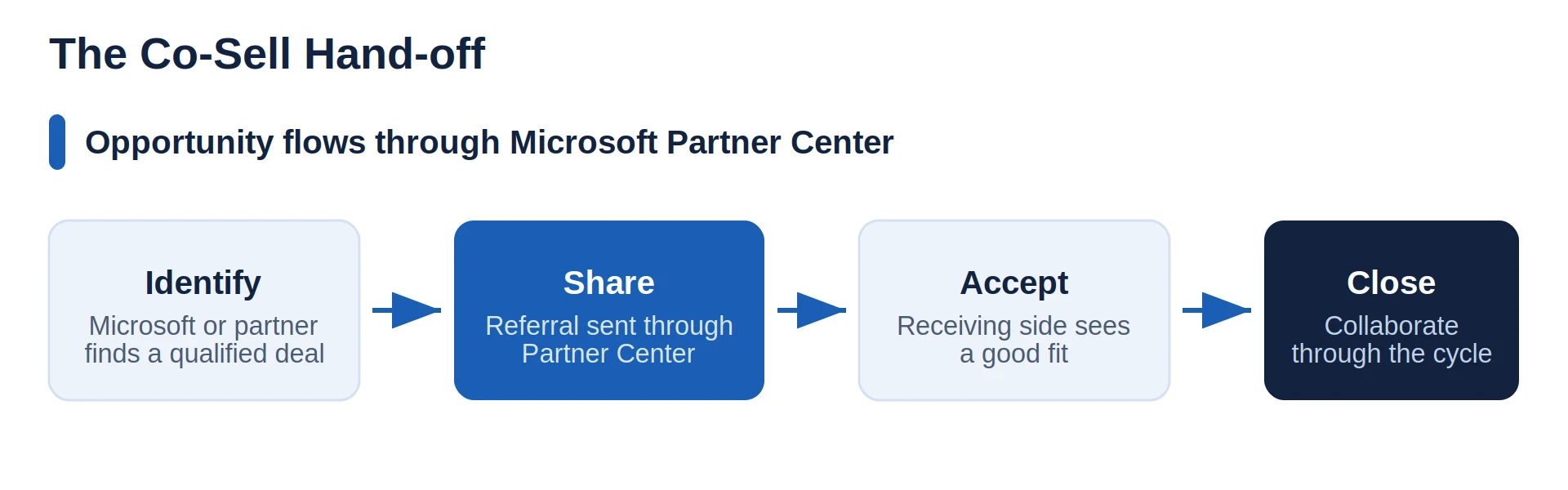
It starts when Microsoft or a partner identifies a qualified sales opportunity and shares it through Microsoft Partner Center. If the receiving side sees a good fit, they accept it and collaborate through the sales cycle to close the deal. That simple hand-off is the heart of co-selling on Microsoft Azure Marketplace.
In practice, Microsoft co-sell gives software vendors access to Microsoft’s enterprise sales force, MACC-eligible buyers, and larger deal sizes than they would win on their own.
Who Benefits Most From Co-Selling With Azure?
Co-selling on Microsoft Azure Marketplace is not equally valuable to every software company. It pays off most for a specific profile of ISV, and it is worth knowing early whether that is you. This is really the core of why co-sell is important for cloud service providers: it rewards the vendors set up to use it.
- ISVs with an Azure-based solution. Azure IP Co-sell Eligible status, the tier that unlocks the deepest Microsoft seller engagement, requires your solution to be primarily platformed on Azure. If you are already building on Azure, you clear the hardest requirement by default.
- Vendors selling into enterprise and mid-market. Co-sell works best when deals are large enough to earn Microsoft field-seller attention and when buyers hold a Microsoft Azure Consumption Commitment (MACC) to draw down. Purchases that count toward a customer’s MACC become far more attractive, which is a real part of the benefits of co-selling with cloud providers.
- Companies with limited field sales coverage. If a global direct sales team is out of reach, co-selling effectively lends you Microsoft’s. Their field sellers can walk your solution into accounts you would never open on your own.
- ISVs ready to operate, not just enroll. The vendors who win treat co-sell as an ongoing motion: they respond to referrals quickly, keep relationships with sellers warm, and keep their pipeline synced. The ones who set it and forget it rarely see much back.
If your solution runs on Azure, you sell into organizations with Microsoft commitments, and you are ready to run the motion actively, co-selling on Microsoft Azure Marketplace becomes one of the highest-leverage growth channels open to you.
SaaSify as a Microsoft Marketplace Growth Lever
Cloud marketplace teams tend to agree on one thing: operational excellence is what separates the ISVs who scale from the ones who stall. The co-selling structure is complex and the requirements are strict, which turns co-selling with Microsoft Azure into a resource-heavy job. That pushes many vendors into a do-it-yourself approach that quietly slows their growth, and it hits hardest for ISVs with limited people or in-house expertise.
SaaSify takes that weight off the team. With no-code integration and a self-service platform you can shape to your own process, it gives ISVs a straightforward way to run their cloud marketplace operations end to end and keep growth steady. With SaaSify, ISVs can:
- Automate the entire co-selling with Azure workflow and run every operation from one dashboard.
- Connect their HubSpot or Salesforce CRM to the Azure Marketplace and manage everything without switching context.
- Automate the full private-offer creation lifecycle and capture more revenue.
- Use real-time metrics and data-driven insight to shape cloud GTM strategies that fit their market.
- Track deal status through real-time alerts on Slack, MS Teams, or email.
- Stay compliant with shifting marketplace rules while SaaSify’s experts handle the moving parts.
Beyond the technical and operational support, SaaSify guides ISVs on the strategy behind co-selling with Azure: how to work through the co-sell program without friction, how to build cloud GTM strategies that move revenue, how to prepare marketing collateral for specific deals, how to sharpen co-sell narratives that lift engagement, and how to turn data-driven insight into decisions you can act on.
The result: SaaSify reshapes how you manage the marketplace lifecycle and grows your SaaS revenue, with no revenue sharing taken by the platform.
How Does Microsoft Azure Co-Selling Work?
To work inside the Microsoft Azure co-sell ecosystem, a few concepts need to be clear first. Each one shapes how co-selling on Microsoft Azure Marketplace plays out day to day.
Co-sell Opportunities on Microsoft Azure Marketplace
Co-sell opportunities are the raw material of co-selling on Microsoft Azure Marketplace: potential deals or projects where ISVs and Azure sellers, channel partners, or two Azure partners team up to study a customer’s need and answer it with a tailored offer. Working the deal together raises the odds of closing it.
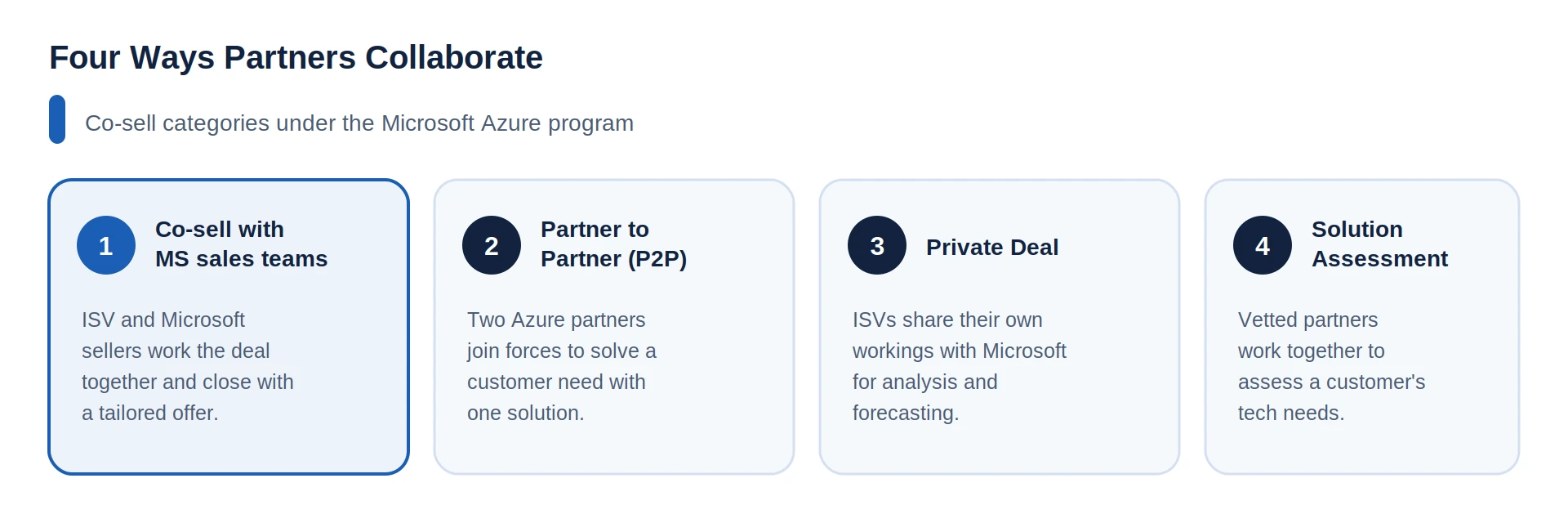
There are several levels of engagement, called Co-sell Categories, that define how partners collaborate. They include:
- Co-sell with Microsoft sales teams: the ISV and Microsoft sellers work the identified opportunity together and close with an offer that fits the customer’s business.
- Partner to Partner (P2P): two Azure partners join forces to solve a customer’s need with one of their solutions.
- Private Deal: ISVs share their own workings with Microsoft for analysis and forecasting. No sales collaboration happens here.
- Solution Assessment (SA): partners vetted by the Assessment Business team work together to assess a customer’s technology needs.
Co-Sell Eligibility and Statuses
Before Microsoft sellers can co-sell your solution, your offer has to earn a co-sell status. At a baseline, that means:
- An active Microsoft AI Cloud Partner Program membership,
- A published (and, for the top tier, transactable) listing on Microsoft Marketplace,
- A completed business profile in Partner Center,
- A sales contact for each co-sell geography, and your co-sell documents: a one-pager, a pitch deck, and a reference architecture diagram for most offer types.
Meeting these is what puts you in a position to sell on Azure Marketplace with Microsoft’s sellers behind you. Getting clear on the Azure IP co-sell requirements early saves a lot of backtracking later.
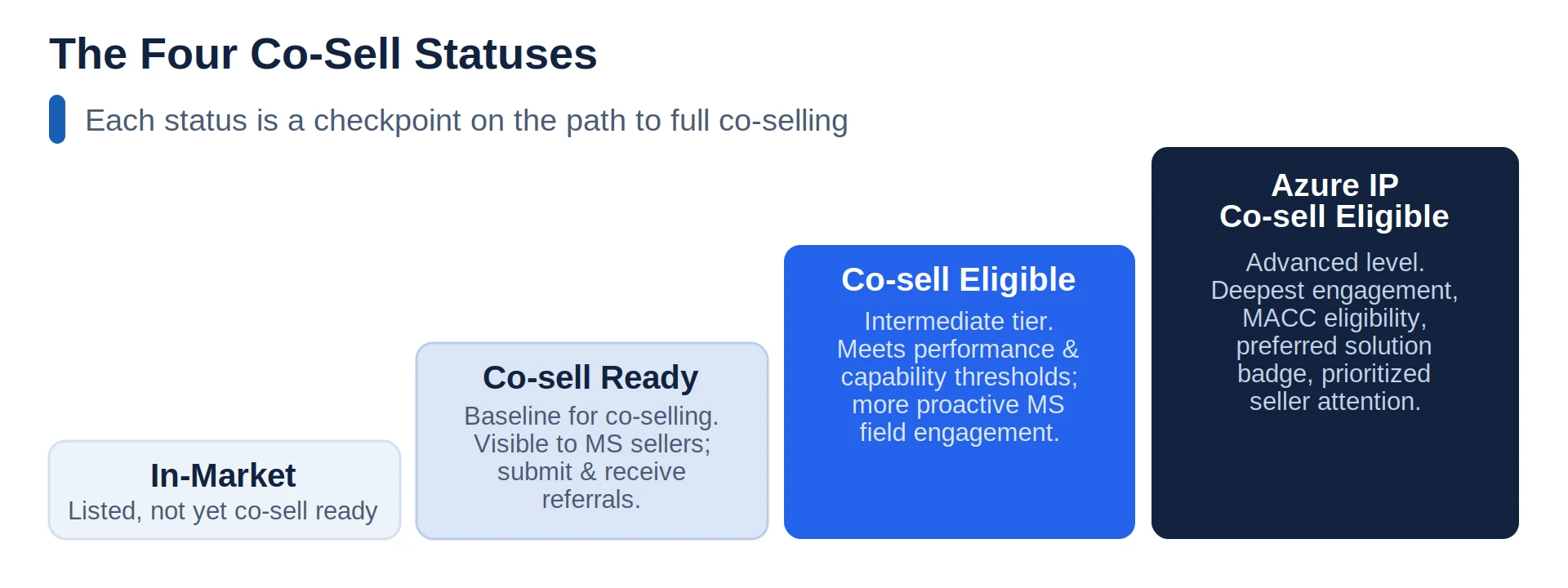
A co-sell status labels each solution with its eligibility level and the benefits that come with it. It tells you where your offer stands today and what it takes to reach the next tier. Every status is a checkpoint on the path to full co-selling on Microsoft Azure Marketplace. There are four statuses:
- In-Market: solutions that are listed but have not yet met the co-sell-ready requirements. In-Market ISVs cannot collaborate with Microsoft sellers directly yet, though they can still work with other Azure partners as attached solutions.
- Co-sell Ready: the baseline for co-selling with Microsoft sellers. Your solution meets the basic requirements, becomes visible to Microsoft sellers in their internal systems, and you can submit and receive referrals through Partner Center.
- Co-sell Eligible: an intermediate tier for solutions that meet defined performance and capability thresholds, which unlocks more proactive Microsoft field engagement than Co-sell Ready.
- Azure IP Co-sell Eligible: the advanced level. It offers the deepest engagement with Microsoft sellers and unlocks MACC eligibility, so your offer can count toward a customer’s Microsoft Azure Consumption Commitment. It is built for partners who have developed intellectual property on Azure, and these solutions get prioritized seller attention plus a Microsoft preferred solution badge.
The two tiers most ISVs care about are Co-sell Ready and Azure IP Co-sell Eligible. Here is how they differ in practice:
| Co-sell Ready | Azure IP Co-sell Eligible | |
|---|---|---|
| What it unlocks | Visibility to Microsoft sellers; ability to submit and receive referrals | Deepest seller engagement; MACC eligibility; preferred solution badge |
| Core requirement | Published Marketplace listing plus co-sell documents | Everything in Co-sell Ready plus the requirements below |
| Revenue threshold | None | At the org level, at least USD 100,000 of Azure Consumed Revenue or Marketplace Billed Sales over trailing 12 months (Azure credits/ACO do not count) |
| Technical bar | — | Microsoft technical validation / reference architecture review; solution primarily platformed on Azure; transactable listing |
| MACC | Not MACC-eligible | Prerequisite for MACC eligibility |
For the current, authoritative checklist, SaaSify points ISVs to Microsoft’s own eligibility criteria on Microsoft Learn (Co-sell requirements, Partner Center).
The Co-Sell Process Step by Step
Reaching co-sell is a progression, not a single action. Here is the path to co-selling on Microsoft Azure Marketplace, from a standing start to Azure IP Co-sell Eligible.
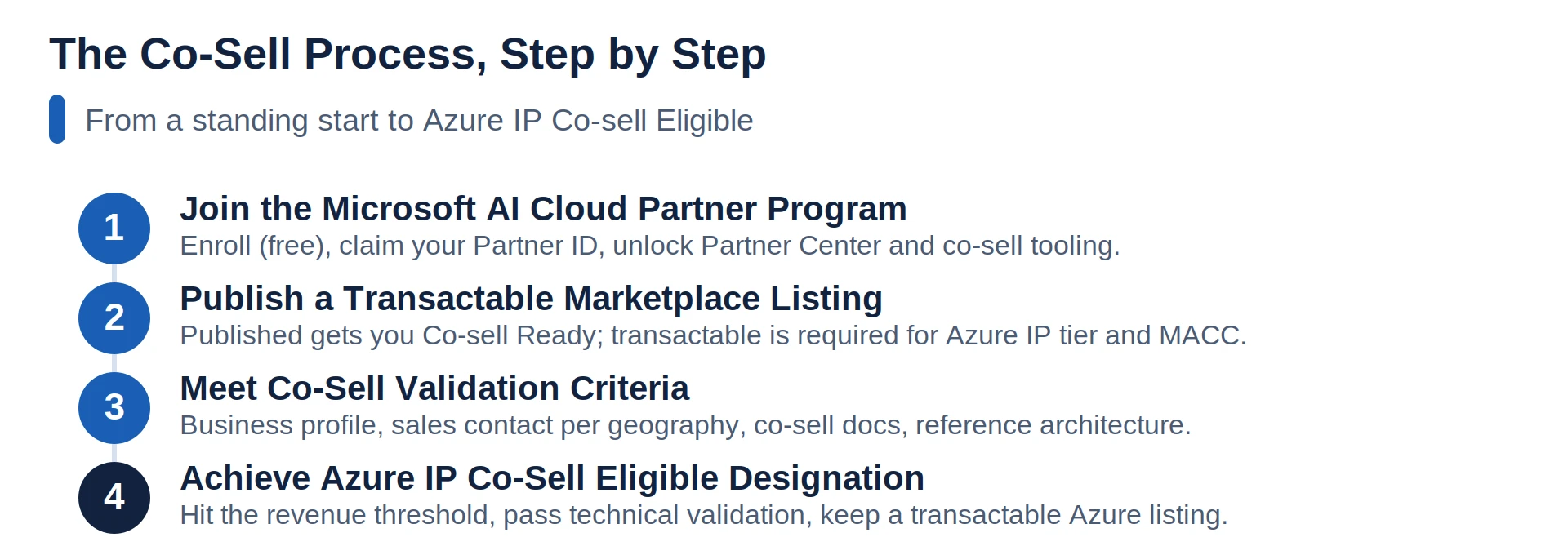
Step 1: Join the Microsoft AI Cloud Partner Program (MAICPP)
Enroll in the Microsoft AI Cloud Partner Program and claim your Partner ID (formerly the MPN ID) in Partner Center. Enrollment is free, and it opens up Partner Center, the co-sell tooling, and a route toward Solutions Partner designations.
Step 2: Publish a Transactable Marketplace Listing
Publish your offer live so you can sell on Microsoft Marketplace. A published listing gets you to Co-sell Ready; a transactable listing is the extra step required for Azure IP Co-sell Eligible status, and therefore for MACC eligibility. Set up metering and pricing so the offer can actually transact, not just appear in the catalog. Clean Azure Marketplace integration here saves headaches downstream.
Step 3: Meet Co-Sell Validation Criteria
Finish the co-sell-ready requirements: a complete business profile in Partner Center, a sales contact for each co-sell-eligible geography, your co-sell documents (one-pager and pitch deck built from Microsoft’s templates), and a reference architecture diagram where your offer type needs one. Once these are submitted and accepted, your solution turns Co-sell Ready and becomes visible to Microsoft sellers.
Step 4: Achieve Azure IP Co-Sell Eligible Designation
Now build toward the advanced tier. Reach the revenue threshold (at the organization level, USD 100,000 of Azure Consumed Revenue or Marketplace Billed Sales over a trailing 12 months), pass Microsoft’s technical validation and reference architecture review, keep your solution primarily platformed on Azure, and maintain a transactable listing. Clear those, and you unlock the deepest seller engagement, MACC eligibility, and the Microsoft preferred solution badge.
Key Benefits of Co-Selling with Microsoft Azure
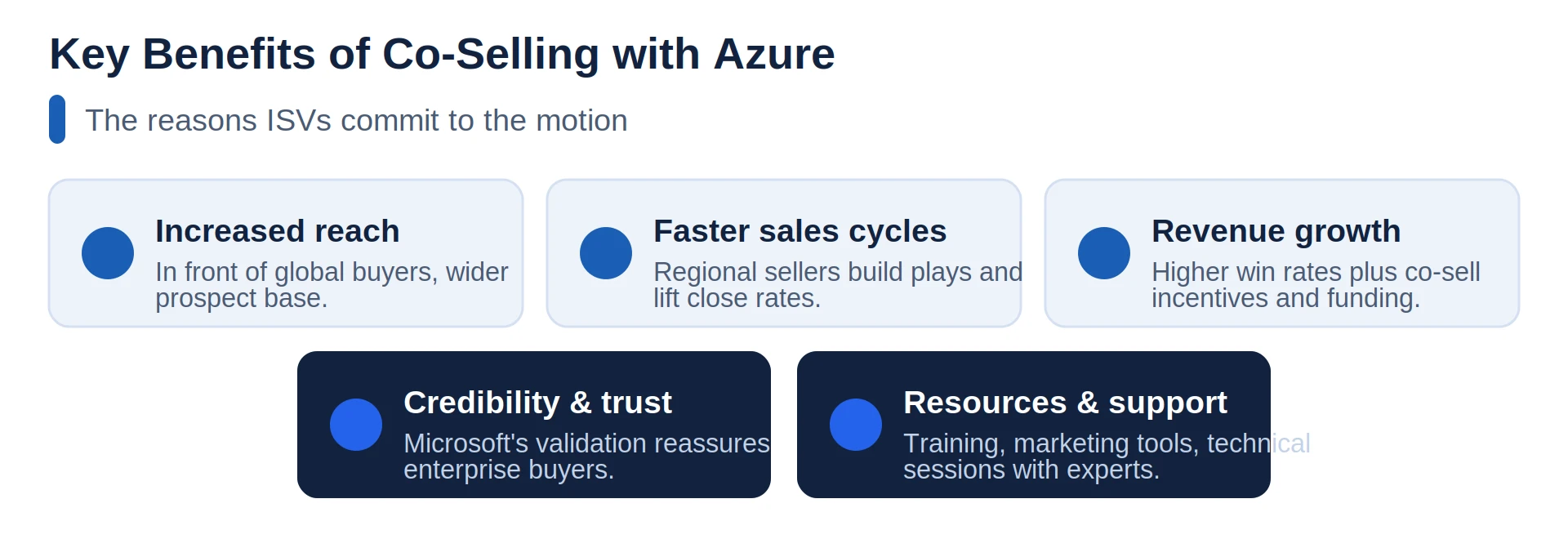
Microsoft built co-sell to make software easier to buy and sell, backed by real support from Azure sellers. There are many angles to it, but these are the benefits of co-selling with cloud providers that matter most, and the reasons ISVs commit to co-selling on Microsoft Azure Marketplace in the first place:
- Increased reach and visibility. Co-selling with Azure puts your offers in front of global buyers, widening your prospect base and your SaaS sales.
- Accelerated sales cycles. Your team works with regional Azure sellers to build co-sell plays and move deals without language or regional friction, which shortens cycles and lifts your close rate.
- Revenue growth and profitability. Selling jointly with Microsoft tends to raise win rates, since both teams push toward the same close. Eligible partners may also earn incentives or funding through Microsoft’s co-sell programs.
- Enhanced credibility and trust. A co-sell partnership signals that Microsoft has vetted your solution, which reassures buyers. People invest more readily in software backed by a name they already trust.
- Access to resources and support. Co-sell eligibility opens Microsoft’s tools and resources to your team, from training to marketing materials to technical sessions with domain experts.
Co-Selling with Microsoft Azure vs. Without Co-Selling
| Factor | With Microsoft Azure Co-sell | Without Co-sell |
|---|---|---|
| Microsoft Sales Support | ISVs get access to Microsoft sellers who help promote and sell their solutions. | No direct sales support from Microsoft. |
| Customer Reach | Your solution gets enhanced visibility to Microsoft’s vast customer base and enterprise clients. | Limited reach; marketing is self-driven. |
| Azure Marketplace Benefits | Offers can count toward a customer’s MACC, making them more attractive. | No MACC benefits, which may reduce buyer incentives. |
| Deal Size & Velocity | Deals close 3x faster and are 6x larger on average. | Deals may take longer with smaller contract values. |
| Co-Sell Incentives | Microsoft provides co-sell incentives to its field teams to promote your solution. | No incentive-driven Microsoft sales engagement. |
| Branding & Trust | Earn Microsoft Preferred Solution status, increasing credibility. | No official Microsoft validation or recognition. |
| Go-To-Market Support | Access to Microsoft marketing, co-branding, and demand generation programs. | ISVs invest independently in marketing and outreach. |
| Technical Validation | Requires technical validation and compliance with Azure Marketplace policies. | No need for Microsoft’s technical validation. |
| Revenue Potential | Higher revenue from expanded reach, incentives, and MACC benefits. | Revenue potential depends solely on self-marketing. |
Working With Microsoft Reps and Channel Partners
Connecting With Microsoft Sellers and Your PDM
Co-sell status makes your solution visible to Microsoft Channel Partners, but relationships are what turn co-selling on Microsoft Azure Marketplace into closed revenue. Your Partner Development Manager, or PDM, where you have one, is your inside advocate: the person who helps you work through programs, reach the right field sellers, and prioritize the opportunities worth chasing.
Beyond the PDM, find the specific Microsoft sellers who cover your segments and regions, hand them enablement they can actually use (a tight one-pager, real customer proof points, a clear better-together story), and keep them posted so you stay top of mind when the right deal appears. Good Microsoft co-sell partners for cloud services live or die on this kind of follow-through.
Co-Sell vs. the Channel Partners Motion: How They Differ
These two get confused constantly, and the difference matters:
- Co-sell is a collaboration. You and Microsoft’s sellers pursue a customer together. Microsoft’s team is incentivized to help you win, but you transact the deal, often through your Marketplace listing, and you keep the customer relationship and the revenue.
- The Channel Partner motion is a resale. A Channel Partner or Cloud Solution Provider (CSP) partner buys or licenses your solution and sells it onward under their own commercial relationship. The reseller owns that customer transaction.
The short version: co-selling adds Microsoft’s Channel Partners to your deal, while reselling hands your deal to someone else. You do not need a channel partner to co-sell with Microsoft. The two are independent motions, and plenty of ISVs run co-sell without ever bringing in a channel partner.
Challenges with Microsoft Azure Co-Sell
Co-selling on Microsoft Azure Marketplace can lift an ISV’s SaaS revenue sharply when it is run well. The catch is the work it takes to run it well. Several of the activities involved are resource-heavy and slow, which keeps co-sell success out of reach for teams that are already stretched thin.
A familiar pattern holds here: the top 20% of ISVs make around 80% of the marketplace generated revenue. This means a small share of sellers captures most of the marketplace revenue, and those sellers have built a durable cloud GTM approach that keeps their sales team efficient through the right tools. The rest of this section covers the challenges that keep ISVs from reaching that group.
Navigating the Complexity of Various Co-sell Programs
Microsoft runs multiple co-sell programs (Co-sell Ready, Azure IP Co-sell, and more), each with its own requirements, benefits, and criteria. Picking the right one and keeping up with shifting policies can overwhelm a small team. Even where eligibility is a hurdle, the platform still leaves room to partner with other ISVs on deal promotion and joint solutions.
Aligning Sales and Marketing Efforts
Co-selling depends on tight collaboration between your team and your Microsoft counterparts. Coordinating across teams and syncing joint plans is hard work. Leading ISVs use SaaSify’s CRM connectors and unified dashboard to keep communication with partner sellers in one place and scale the joint effort.
Context Switching and Operational Efficiency
Most ISVs run on CRMs like HubSpot and Salesforce, and wiring those into Microsoft’s co-sell platform is not simple. Without clean data syncing, teams lose track of opportunities, drop shared leads, and lose visibility into deal progress, which costs revenue. It hits resource-limited teams hardest, dragging on efficiency and stretching sales cycles.
SaaSify’s CRM connector for HubSpot and Salesforce handles that integration with zero engineering change, so teams run the whole co-sell workflow from their own CRM without switching context or learning a new tool.
Meeting Requirements and Ensuring Compliance
Reaching Co-sell Ready, and especially Azure IP Co-sell status, takes real investment in solution assessments, sales enablement, and marketing collaboration. Keeping up with Microsoft’s changing requirements adds another layer.
SaaSify helps teams meet the revenue criteria by streamlining the co-sell process and backing it with data-driven insight that closes deals faster. Its experts track the marketplace’s shifting compliance needs and fold the answers into the platform, so you stay focused on the rest of the business.
Measuring ROI and Demonstrating Value
Tracking co-sell activity and proving its impact is rarely straightforward, which makes it hard to see what to improve or where to adjust. SaaSify gives ISVs real-time performance analytics that measure co-sell effectiveness across deal status, engagement, and revenue impact. It also surfaces benchmarks like deal velocity and win rates, so teams can refine their approach, deepen partner engagement, and tune the pipeline for better returns.
Common Co-Sell Mistakes to Avoid
Even ISVs who clear the eligibility bar leave money on the table through a few avoidable mistakes. These are the ones that quietly undercut co-selling on Microsoft Azure Marketplace:
- Stopping at Co-Sell Ready. Co-sell Ready makes you visible, but Azure IP Co-sell Eligible is where the real seller engagement and MACC eligibility live. Treating the baseline as the finish line caps your upside. Build toward the advanced tier on purpose.
- A weak better-together value story. Microsoft sellers are short on time and long on partners competing for it. If you cannot say in one line how your solution plus Azure solves a customer problem better than either alone, sellers will move on. Lead with the joint customer outcome, not the feature list.
- Slow response to Microsoft referrals. A referral has a short shelf life. Take days to respond and you signal you are not a dependable co-sell partner, and the referrals dry up. Fast, steady response is what keeps them coming.
- Running co-sell operations manually. Copying opportunities between your CRM and Partner Center by hand breeds errors, delays, and blind spots, and it does not scale. That is the operational trap the next section takes apart.
Best Practices for Co-Selling with Microsoft Azure
Microsoft’s co-sell program has been running since 2017, and the teams who do well at co-selling on Microsoft Azure Marketplace tend to share a few habits. These best practices for co-selling with Microsoft Azure are the ones worth copying:
- Understand the programs inside and out. Know what Co-sell Ready and Azure IP Co-sell Eligible actually require, from solution assessments to sales enablement to performance metrics. That clarity tells you where to spend effort and where the ROI sits.
- Set a tailored narrative. Spell out how your solution solves a specific customer problem and what it is worth in business terms. Skip the jargon, lead with outcomes, and adjust the message for IT buyers, business decision-makers, and Microsoft sellers, since each cares about different things.
- Build strong relationships with Microsoft sellers. Find the sellers who cover your market and reach out. Give them enablement they can use: success stories, technical detail, ready answers. Stay in touch so you are aligned when a joint opportunity lands.
- Use the Microsoft marketplaces well. Build clear, informative listings on Azure Marketplace or AppSource, with the right keywords, real benefits, and customer proof. Then follow up on the leads they generate, promptly.
- Invest in sales and technical enablement. Train your sales and technical teams on your solution, on Microsoft’s sales process, and on co-sell practice. Joint training with Microsoft sellers keeps both sides telling the same story.
- Collaborate on joint marketing. Build a shared marketing plan with your Microsoft counterparts, with clear activities, audiences, and metrics, and create co-branded assets that borrow the credibility of both names.
- Track progress and measure results. Watch metrics like lead generation, deal registration, and revenue growth. Report on them regularly and use what you learn to adjust the strategy.
How to Measure Co-Sell Success: Metrics and KPIs
Co-selling on Microsoft Azure Marketplace is only as good as the pipeline it produces, and the ISVs who scale it treat it as a measurable motion. These are the metrics that matter most:
- Co-sell pipeline influenced. The total value of opportunities where Microsoft co-sell played a part. This is the headline number that keeps the investment justified.
- Referral response time. How fast your team acts on a Microsoft referral. Quicker responses reliably lead to more referrals over time.
- Referral-to-opportunity conversion. The share of referrals that turn into qualified opportunities. A low rate usually points to a targeting or fit problem.
- Win rate, co-sold versus solo. Co-sold deals should win more often. If they do not, the better-together story or the seller alignment needs work.
- Deal velocity. Time from opportunity to close on co-sold deals. Co-sell should compress it, so track it and prove it.
- Average deal size. Co-sold and MACC-eligible deals should run larger than your solo average.
- MACC-eligible revenue. The share of co-sold revenue that counts toward customers’ Azure commitments, a strong signal of enterprise traction.
Track these steadily, hold them against your solo-sales baseline, and let the gaps tell you where to invest next, whether that is better collateral, faster response, or deeper seller relationships.
How SaaSify Streamlines Azure Co-Selling for ISVs
SaaSify starts by helping your team meet the technical requirements for Co-sell Ready status and then push toward Azure IP Co-sell eligibility, making sure your SaaS offers are listed, managed, and tuned on the Azure Marketplace so you capture more sales through cleaner operations, CRM integration, and real insight. As one of the platforms built for Microsoft marketplace co-selling enablement services, it handles the operational weight so your team keeps selling.
Here is how the SaaSify team helps you run co-selling on Microsoft Azure Marketplace end to end and lift your opportunity-to-cash conversion:
Co-selling Readiness on Microsoft Azure Marketplace
SaaSify’s customer success team knows the Azure co-selling lifecycle can get complicated. So its experts make sure partners understand the process and have the tools, knowledge, and collateral to work it, on top of being co-sell eligible. Breaking the requirements into steps, they help your sales team:
- Prepare sales and marketing collateral.
- Get pointed to the right study materials, like Microsoft’s MCEM program, to understand the co-selling ecosystem and build strategy around it.
- Identify co-sell opportunities.
- Build effective co-sell narratives.
- Analyze a buyer’s solution requirements using data-driven insight.
- Prepare a private offer that matches the buyer’s intent.
- Fast-track private-offer creation with field mapping.
- Automate the full offer-creation cycle.
- Raise co-sell requests quickly through automation.
- Work with cloud partners to close deals faster.
Automated Metering and Billing
For SaaS, usage-based billing is what makes flexible pricing possible and helps close deals. With SaaSify, ISVs choose between two pricing structures when building private offers: unit pricing and subscription offers. SaaSify connects to Azure’s metering services to automate usage tracking and invoicing, which cuts operational overhead and keeps billing accurate for faster approval and revenue recognition, and makes you easier for Microsoft sellers to work with.
Data-Driven Insights
SaaSify gives ISVs real-time access to marketplace metrics through CRM integration and two-way sync, plus reporting and analytics that build a history of customer need and support tailored private offers. Together, that is a strong setup for closing: your team can spot the right co-sell opportunities, read the history to understand what a buyer needs and how to price it, and refine the approach to convert more.
Instant Alerts on Deal Status
SaaSify sends real-time deal-status alerts on whatever channel your team uses, Slack, MS Teams, or email, so sellers can act the moment something moves. The transparent tracking gives the whole team visibility into deal progress, so people act without waiting on another division.
Automate Co-Selling with Microsoft Azure
For a lot of ISVs, running co-selling on Microsoft Azure Marketplace by hand feels more like overhead than growth. Jumping between systems, keying in data, chasing insight for opportunity creation, and keeping communication aligned with partner sellers eats time and energy.
Challenges of Manual Co-selling with Microsoft Azure
Run manually, co-sell pipelines on Microsoft Azure create a familiar set of problems for ISVs and software sellers:
- Context switching. Bouncing between CRMs (Salesforce, HubSpot, Zoho) and Microsoft Partner Center to create or submit opportunities is slow and inefficient, and the friction leads to delays and missed collaboration.
- Steep learning curve. Submitting through Partner Center takes specific platform knowledge. Teams end up training people or hiring for it, which raises cost and slows adoption.
- Manual data-entry errors. Copying opportunity data from CRM into Partner Center invites mistakes. Teams lose hours a week fixing them, which dents accuracy and trust in the process.
- Building custom integrations. Some ISVs try to build their own CRM-to-Partner-Center integration, but it is resource-heavy and pulls engineering off the core product.
- Inconsistent tracking and visibility. Watching opportunity progress in Partner Center is painful without automated syncing. Teams toggle between systems for updates, which slows response and weakens collaboration with Microsoft’s field sellers.
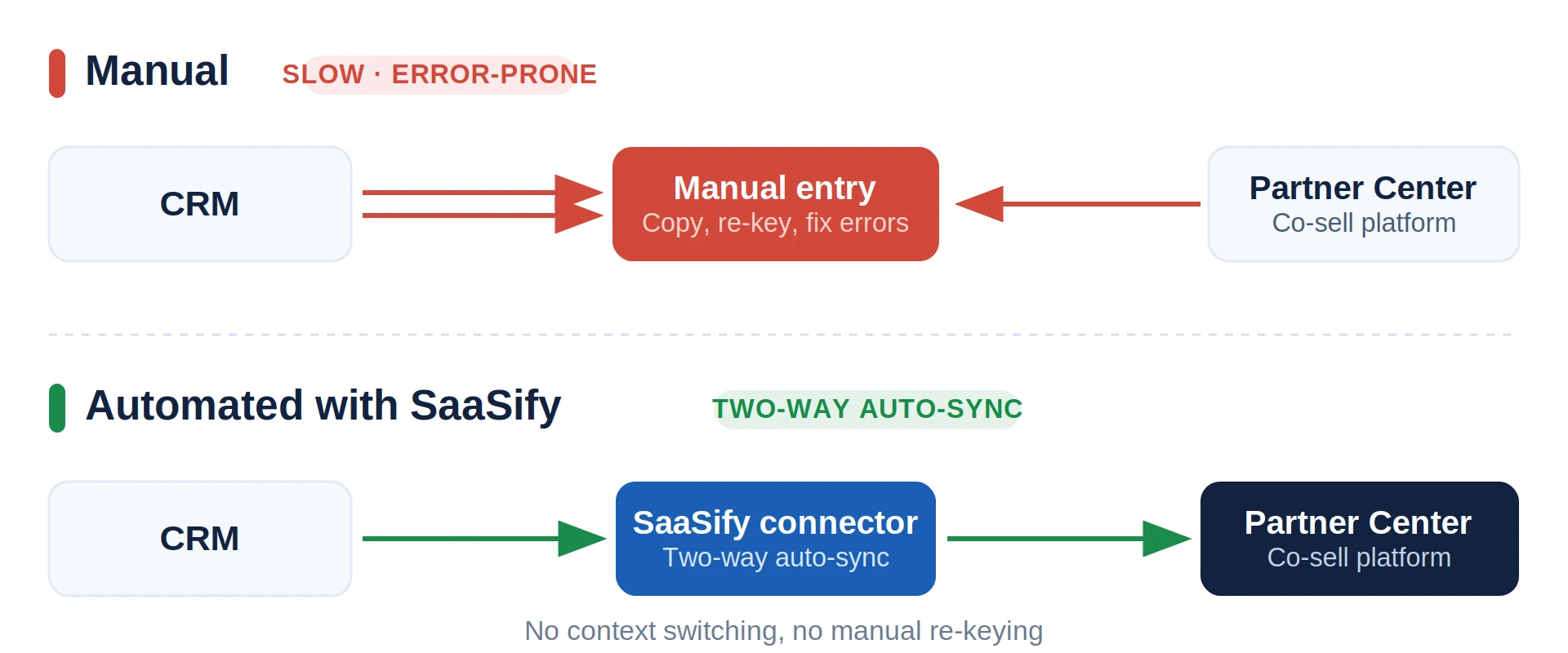
Automating the Microsoft Azure Co-selling Workflow
With SaaSify’s native CRM connectors for Salesforce and HubSpot, teams run the entire co-sell workflow inside their CRM. Here is what that automation covers:
- Bi-directional opportunity sync. Create, update, view, and assign opportunities, and accept invitations to engage on Microsoft Azure co-sell referrals, all inside your CRM, with near real-time sync to Microsoft Partner Center’s co-sell platform.
- Effortless opportunity creation. Turn CRM opportunities into Microsoft Azure co-sell deals in a click. Pull your published solutions from Partner Center and attach specific listings, Azure services, or Azure Marketplace offers to each opportunity.
- Real-time collaboration with Microsoft sellers. Work with Microsoft field sellers directly, with no system-switching.
- Instant updates and notifications. Stay aligned through real-time status updates on Microsoft Teams, email, or your channel of choice across the deal lifecycle.
- Dynamic insights dashboard. Read co-sell performance from a customizable dashboard and make calls faster.
- Cost optimization and impact. Move the co-sell pipeline without adding overhead, so you use resources better and lift revenue potential.
- Decentralized pipeline management. Let teams view and manage opportunity status without deep Partner Center knowledge, which improves visibility, accountability, and reporting across business units.
Co-selling with Microsoft Azure: The SaaSify Advantage
Co-selling on Microsoft Azure Marketplace has become central to how ISVs succeed on Azure. Keeping pace with it, though, especially with programs like the Microsoft Commercial Marketplace and multiparty private offers (MPOs), is a real challenge. That is where a knowledgeable partner earns its keep, and it is a big part of what to look for in the best platforms for co-selling with partners.
As Microsoft keeps evolving its co-sell programs and partner models, SaaSify commits to end-to-end support for ISVs who want to co-sell with Microsoft Azure Marketplace and scale inside the Azure ecosystem. With SaaSify, ISVs can:
- Stay updated with zero effort. A dedicated team of cloud marketplace specialists tracks Microsoft’s partner and marketplace programs, and the platform adapts to shifts in co-sell and listing structures, so you are not the one deciphering new policy.
- Automate co-sell operations with Microsoft. SaaSify connects to Microsoft’s Partner Center and your CRM to automate the whole lifecycle, from opportunity registration and lead referrals to deal tracking, reporting, private offers, and multiparty deals. Its no-code Microsoft CRM connector removes the need to build and maintain custom API integrations.
- Tap into deep co-sell expertise. SaaSify’s experience with Azure Marketplace and Microsoft’s co-sell ecosystem gives you an edge, from optimizing listings for co-sell readiness to working with programs like Azure multiparty private offers, with hands-on help at every step.
Conclusion: Turning Azure Co-Sell into Enterprise Revenue
Co-selling on Microsoft Azure Marketplace is a genuine growth lever for ISVs who want more marketplace visibility and more scale. The reach behind it is real: Microsoft puts marketplace solutions in front of millions of customers, including 95% of the Fortune 500, and once you reach Azure IP co-sell status, you gain access to 500,000 Microsoft partners and a global sales force.
The money moving through the channel is substantial too. Since the co-sell program began, Microsoft reports it has jointly sold more than $22.1 billion in partner revenue through partner apps and services, and it now sees over 300 percent increase in customers with a MACC buying through marketplace. Looking ahead, an Omdia study cited by Microsoft frames the marketplace as a $300B partner services revenue opportunity by 2030.
For ISVs, that combination of committed cloud budgets, a large partner ecosystem, and Microsoft’s field sellers is what turns marketplace presence into high-value deals. But getting success takes planning, execution, and alignment with Microsoft’s priorities. Partnering with SaaSify smoothens the journey into co-selling on Microsoft Azure Marketplace, cuts the complexity, sharpens your co-sell readiness, and speeds up closes.
Whether you are just starting or tightening an existing strategy, SaaSify helps you get the most out of the Microsoft Azure Marketplace without the setup grind.
Ready to sharpen your Azure co-sell drive? Talk to the SaaSify experts to see what it looks like for your team.
Frequently Asked Questions
What does co-selling with Microsoft mean?
Co-selling with Microsoft means an ISV and Microsoft’s field sellers pursue the same customer opportunity together, sharing referrals through Microsoft Partner Center and working the sales cycle jointly. The ISV keeps the customer relationship and transacts the deal, usually through its Azure Marketplace listing.
How do I qualify for Microsoft co-sell?
Join the Microsoft AI Cloud Partner Program, publish your solution so you can sell on Microsoft Marketplace, complete your Partner Center business profile, add a sales contact per co-sell geography, and submit your co-sell documents (one-pager, pitch deck, and a reference architecture diagram where required) to reach Co-sell Ready status.
How long does the co-sell process take?
It varies. Co-sell Ready can come quickly once your listing and documents are in place. Full co-selling on Microsoft Azure Marketplace at the Azure IP Co-sell Eligible tier takes longer, since it depends on hitting the revenue threshold and passing technical validation, which can run into months depending on your Azure traction.
Do I need a reseller to co-sell with Microsoft?
No. Co-sell and the reseller (CSP) motion are independent. Co-selling adds Microsoft’s sellers to your deal while you keep the transaction; reselling hands the customer transaction to a partner. Many ISVs co-sell without ever using a channel partner.
What is IP co-sell vs. Marketplace co-sell?
Marketplace co-sell broadly means co-selling solutions listed on Microsoft Marketplace. Azure IP Co-sell Eligible is a specific advanced status for IP solutions primarily platformed on Azure that meet Microsoft’s revenue and technical-validation requirements, and it unlocks the deepest seller engagement and MACC eligibility. In short, IP co-sell is the advanced tier; Marketplace co-sell is the broader motion.
What are the benefits of co-selling with Microsoft Azure?
Access to Microsoft’s enterprise sellers, more visibility to MACC-holding buyers, larger and faster deals, co-sell incentives that motivate Microsoft’s field teams, and the credibility that comes with Microsoft validation.
What platforms provide ISV onboarding and co-sell opportunities?
Platforms like SaaSify handle ISV onboarding and open up co-sell opportunities by connecting your CRM to Microsoft Partner Center, automating listing and private-offer work, and guiding you from Co-sell Ready through Azure IP Co-sell Eligible. That is the practical answer for teams selling on the Microsoft Azure Marketplace.
Though the process requires careful planning, execution, and alignment with Microsoft’s sales priorities, partnering with SaaSify streamlines the Azure co-sell journey, reduces complexity, improves co-sell readiness, and accelerates deal closures. Whether you’re just starting or looking to enhance your existing co-sell strategy, SaaSify empowers you to make the most of Microsoft Azure’s marketplace ecosystem without the setup hassle.
Ready to redefine your Azure co-sell drive? Connect with SaaSify experts to learn more!