Advantages of Buying Software Through Cloud Marketplaces

By Amit MalikOct 1, 2026 · 5 min read

TL;DR

  • Cloud marketplaces are storefronts operated by AWS, Microsoft Azure, and Google Cloud where enterprises procure third-party software against their existing cloud contracts and invoices.

  • AWS partners in ISV Accelerate and Seller Prime close deals 50% faster with deal sizes 4 to 5 times larger than direct sales channels.

  • Microsoft Azure Marketplace private offers can be created and delivered in under 15 minutes, with 100% of an eligible purchase applying toward the customer's Azure Consumption Commitment by default.

  • Google Cloud Marketplace qualifying channel private offers count 100% toward the customer's committed Google Cloud spend, capped at 25% of the total commitment.

  • The buyer side is pulling this forward. The ISV side requires an operational layer that automates listing, private offers, co-sell, funding, and CRM sync across all three clouds. SaaSify is the agentic Cloud GTM platform built for that.

What is a cloud marketplace?

A cloud marketplace is a digital storefront run by a hyperscale cloud provider where enterprise customers discover, purchase, deploy, and manage third-party software alongside the provider's own services. The three platforms that dominate enterprise procurement are AWS Marketplace, Microsoft Azure Marketplace, and Google Cloud Marketplace.

They share an underlying principle: the buyer transacts through an existing cloud relationship, so contracting, billing, and budget approval mechanics are already in place before the software conversation starts.

AWS Marketplace, Microsoft Azure Marketplace, and Google Cloud Marketplace each let enterprise buyers discover, negotiate, and purchase third-party software through the cloud contract they already have in place. Eligible purchases can draw down against committed cloud spend, run through a pre-approved billing relationship, and land on an invoice the finance team already processes every month.

What has changed in the last two years is the scale of the shift. Marketplace is no longer an alternative procurement channel.

  • Canalys forecast the channel to reach $45 billion, growing at an 84% CAGR, and noted that marketplace fees have compressed from upwards of 20% down to 3% across the major providers.

Enterprise procurement teams are building marketplace purchasing into their cloud commitments by design. For ISVs, this means that being listed but not operationally ready to transact, co-sell, and capture funding is increasingly the same as not being listed at all.

What are the benefits of buying software through cloud marketplaces?

Five benefits show up consistently across marketplace-influenced enterprise deals. Each addresses a different procurement bottleneck.

Faster software procurement

Speed is the benefit enterprise buyers name first.
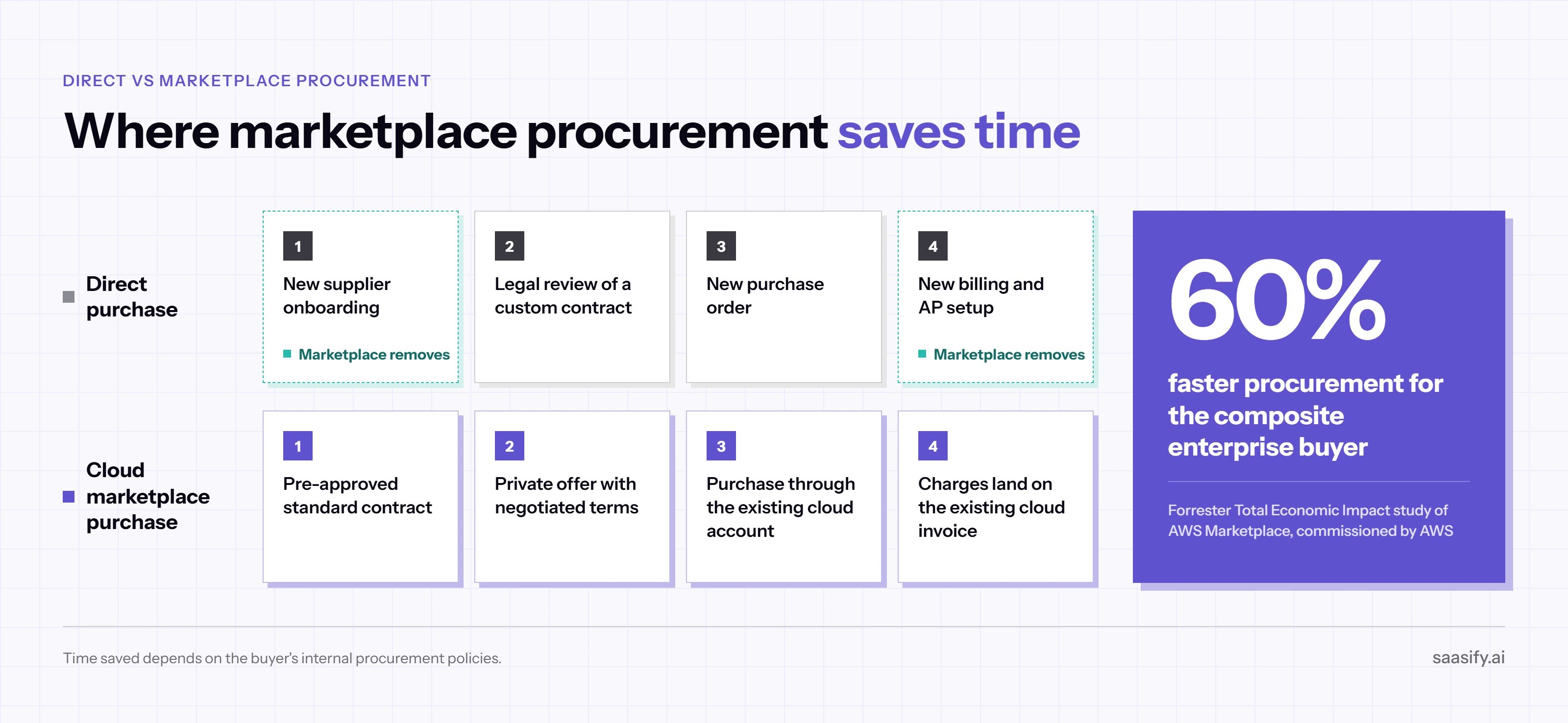
Advantages of Buying Software Through Cloud Marketplaces
  • Microsoft's own Azure blog confirms that private offers can be created and delivered in under 15 minutes, which collapses the negotiation-to-signature step that traditionally eats weeks.

Where does the time actually get recovered? Primarily in contracting and onboarding. Standardized contract options are available on each marketplace (AWS, for example, offers its Standard Contract that organizations can pre-approve and apply across thousands of solutions), and the PO flows through an existing billing relationship rather than triggering a brand-new vendor setup. For enterprises whose internal review and onboarding processes normally add weeks of calendar time, that compression is real and measurable.

Committed cloud spend as a budget lever

Every hyperscaler now offers a mechanism for eligible marketplace purchases to draw down against the customer's cloud commitment. When the conditions are met, the practical effect is significant: software procurement gets funded from money that was already committed rather than money that has to be found and approved separately.

  • Microsoft Azure. Offers that meet Azure benefit-eligible criteria contribute 100% of their pre-tax value against the customer's MACC. Microsoft has reported a 300%+ increase in MACC customers buying through the marketplace and applies the full purchase toward the commitment by default when those criteria are met.

  • Google Cloud. Qualifying software purchases through authorized channel partners count 100% toward a customer's committed Google Cloud spend, subject to a 25% cap on the total commitment.

  • AWS. EDP-eligible marketplace purchases draw down against the customer's Enterprise Discount Program commitment, with eligibility determined at the product level.

The operational implication for ISVs is direct: if your offers are not eligible for committed-spend treatment on the clouds your buyers use, you are losing the single most powerful financial argument for marketplace procurement.

Streamlined contracting and vendor onboarding

Marketplace contracting options can significantly reduce legal and procurement friction. AWS Marketplace, for example, publishes a Standard Contract that buyers can pre-approve once and apply across thousands of vendors. Private offers layer negotiated terms on top without triggering a full vendor-onboarding cycle. Microsoft and Google offer comparable standardized-contract options on their platforms.

How much friction this removes depends on the enterprise. Organizations with mature onboarding processes that normally require weeks for each new supplier see the largest compression. The benefit is real, but it varies with the buyer's internal policies rather than being automatic.

Consolidated billing across the software stack

Marketplace purchases can roll onto the buyer's existing cloud invoice, which reduces the number of independent billing relationships an enterprise manages. AWS confirms that marketplace software charges appear on the regular AWS bill. For enterprises managing 100+ SaaS vendors, reducing AP setup, vendor-master entries, and separate payment workflows is a meaningful operational win.

Larger deals with more pricing flexibility

The same infrastructure that accelerates procurement also enables bigger, more flexibly structured deals.

  • AWS. Partners in ISV Accelerate and Seller Prime see deal sizes 4 to 5 times larger than direct sales channels, with co-sell-influenced deals showing deal sizes 80% larger and win rates 27% higher. A Canalys study found 65% of partners close deals faster by co-selling with AWS, and 54% report larger deals as a result.

  • Microsoft Azure. Private offers let partners negotiate custom terms, pricing, and payment structures, with the entire eligible purchase applied toward MACC by default.

  • Google Cloud. Private offers support contracts up to 5 years with flexible billing cycles, commitment rollover between installments, bonus credits, and metric-level discounts on individual product metrics.

When should enterprises buy software through a cloud marketplace?

Cloud marketplaces create the most value when they simplify procurement, help buyers utilize committed cloud spend, or accelerate complex enterprise purchases. They are particularly relevant in the following scenarios:

  • Active committed cloud spend. The buyer holds a commitment with AWS, Microsoft Azure, or Google Cloud and wants to convert it into productive software purchases.

  • Vendor onboarding is a known bottleneck. The existing process adds weeks to every new supplier, and leveraging a hyperscaler's standardized contracting options would clear most of that.

  • Multi-cloud operations. Buyers running two or three hyperscalers get the most procurement flexibility, because they can route eligible purchases against whichever commitment needs drawdown.

  • Enterprise deal sizes. Private offers, negotiated pricing, and custom payment schedules deliver disproportionate value once the purchase crosses the deal-desk threshold.

  • Deployment speed matters. Whether it is a security control under a compliance deadline or a revenue-linked system where every week of delay carries a real cost.

For smaller purchases where the buyer holds no cloud commit and vendor onboarding is already lightweight, a direct purchase works equally well. Mature procurement teams use both routes.

How to measure cloud marketplace ROI

For ISVs, the value of cloud marketplaces extends beyond individual transactions. The larger question is whether marketplace, co-sell, funding, and revenue operations are working together as a scalable GTM motion.

Here is a framework that RevOps and partnerships leaders can run quarterly, using data already in the CRM and the hyperscaler consoles. Trended over time, these metrics tell you whether the motion is compounding or leaking value.

  • Deal velocity. Compare median days from opportunity created to closed-won for marketplace deals versus direct deals in the same segment. A healthy motion shows the gap widening in marketplace's favour quarter over quarter.

  • Average deal size. Compare median ACV across the two channels. Marketplace deals should trend larger, particularly for private offers into buyers with committed cloud spend.

  • Win rate. Closed-won rates for marketplace-influenced pipeline against direct pipeline. Co-sell-influenced deals tend to show the strongest lift.

  • Buyer pull. The share of new pipeline that is inbound or explicitly requested through the marketplace. When that number climbs, your ICP is adopting marketplace as a default procurement path.

  • Committed-spend leverage. The percentage of marketplace TCV that draws down against MACC, EDP, or Google Cloud committed spend. Low share usually points to offers that are ineligible or misconfigured.

  • Co-sell contribution. Ratio of co-sell registrations to closed deals, and the portion of marketplace revenue that was co-sell influenced. Rising ratios mean compounding. Flat ratios mean the motion is stuck in the portal.

  • Funding capture rate. Dollars claimed against dollars available across MDF, POC funding, migration funding, and other hyperscaler programs. The gap here is almost always large.

  • Cost per marketplace dollar. Fully loaded marketplace costs (headcount, tooling, hyperscaler fees) divided by marketplace revenue. This ratio should decline as revenue scales.

How SaaSify automates cloud marketplace operations for ISVs

Scaling cloud marketplace revenue requires the operational infrastructure to manage listings, offers, co-sell, funding, CRM workflows, and revenue across multiple hyperscalers.

SaaSify provides this infrastructure through an agentic Cloud GTM platform that brings marketplace operations across AWS, Microsoft Azure, and Google Cloud into a single system.

  • Marketplace listing. Get listed on all three clouds in days with no engineering effort. SaaSify's agents draft and file listings in about 90 minutes, with full control of branding, pricing, and terms across SaaS, container, AMI, professional services, and AI agent listing types.

  • Private offers and transactable offers. Create transactable offers from a single console. Send, negotiate, and track private offers, CPPO, MPO, and MCPO alongside amendments and renewals, with custom pricing, multi-year terms, installment schedules, and metric-level discounts configurable without switching between hyperscaler consoles.

  • CRM integration. Native Salesforce and HubSpot integrations let sales teams create and send private offers from the opportunity record. Pipeline, offer status, acceptance, and revenue sync back automatically, giving RevOps and finance a single source of truth.

  • Committed-spend eligibility. SaaSify helps ISVs navigate and operationalize the program requirements that make their offers MACC-, EDP-, and Google Cloud committed-spend eligible, and maintains ongoing badge and program hygiene so eligibility does not silently lapse.

  • Funding automation. Most partners leave a large share of hyperscaler incentive dollars unclaimed because the filing process is manual. SaaSify automates AWS funding programs including MDF end to end, tying claims to the deals they influenced. Co-sell automation runs across all three clouds.

  • Co-sell orchestration. Co-sell registration and pipeline sharing across ACE on AWS, Partner Center on Microsoft, and PRM on Google run automatically without engineering time, continuously rather than as a quarterly scramble.

  • Revenue and reconciliation. Every marketplace dollar tracked, reconciled, and attributed across all three clouds, with the granularity finance and audit both need.

  • Agentic automation. SaaSify's agents work the motion in the background continuously: listing hygiene, offer follow-through, funding capture, reconciliation.

Cloud marketplace readiness checklist for ISVs

A scalable marketplace motion depends on a set of core operational capabilities working consistently across clouds, sales systems, and finance workflows.

  • Use this checklist to identify gaps that may be limiting marketplace revenue, slowing execution, or leaving hyperscaler programs underutilized.

  • Your product is listed on every hyperscaler your buyers ask about, with the correct pricing, metadata, and support terms.

  • Your offers are MACC-, EDP-, and Google Cloud committed-spend eligible wherever applicable.

  • Sales creates private offers directly from Salesforce or HubSpot without switching into a hyperscaler console.

  • Co-sell opportunities flow to and from every hyperscaler partner portal automatically.

  • Marketplace pipeline, offer status, acceptance, and revenue all sync back into the CRM in real time.

  • Cloud funding requests are filed as part of the deal cycle, not months after the money was available.

  • Marketplace revenue is reconciled, attributed, and reported at the same cadence and granularity as direct revenue.

  • One named owner is accountable for marketplace metrics quarterly.

Any unchecked item is costing you deals, funding, or accurate reporting. SaaSify closes each of them from a single platform.

Start selling through cloud marketplaces with SaaSify

If your buyers are asking to transact on AWS, Azure, or Google Cloud, the fastest path to a smooth marketplace deal is a partner who has operated this motion at scale. SaaSify handles listing, transactable offers, private offers, CPPO, committed-spend eligibility, funding automation, co-sell, CRM integration, and reconciliation so your team can stay focused on closing.

Get a demo to see how SaaSify pairs an agentic Cloud GTM platform with hyperscaler experts to grow your partnership revenue.

Frequently asked questions

What is a cloud marketplace and how does it work?

A cloud marketplace is a digital storefront operated by a hyperscale cloud provider (AWS, Microsoft Azure, or Google Cloud) where enterprise buyers discover, purchase, and manage third-party software. Eligible purchases can draw down from the buyer's existing cloud commitment and appear on their consolidated cloud invoice.

Is software procurement through cloud marketplaces faster than direct processes?

Forrester's TEI study of AWS Marketplace measured a 60% faster procurement process. AWS partners in ISV Accelerate and Seller Prime close deals 50% faster than direct, and Microsoft Azure Marketplace private offers can be created in under 15 minutes.

Do cloud marketplace purchases count against committed cloud spend?

They can, when the offer meets the relevant eligibility criteria. On Microsoft Azure, benefit-eligible offers contribute the full pre-tax purchase against the MACC by default. On Google Cloud, qualifying channel private offers draw down 100% of committed spend, subject to a 25% cap. On AWS, EDP-eligible marketplace purchases draw down the customer's EDP commitment, with eligibility determined at the product level.

What is a private offer on a cloud marketplace?

A private offer is a negotiated deal between the ISV and a specific buyer, transacted through the marketplace with custom pricing and terms. A channel private offer (CPPO on AWS, MPO on Microsoft, MCPO on Google) adds a channel partner who resells the ISV's product to the end customer through the marketplace.

What is cloud GTM and why does it matter for ISVs?

Cloud GTM (go-to-market) is the strategy and operational infrastructure ISVs use to sell through cloud marketplaces. It covers listing, private offers, co-sell with hyperscaler sales teams, cloud funding capture, CRM integration, and revenue reconciliation. The ISVs generating material marketplace revenue treat cloud GTM as a system, not a side channel.

How large is the cloud marketplace industry?

Hyperscaler cloud marketplace transactions are projected to reach $163 billion by 2030, up from roughly $30 billion in 2024.

Does cloud marketplace procurement work for multi-cloud buyers?

Yes. Buyers with commitments across AWS, Microsoft Azure, and Google Cloud can route eligible software purchases against whichever commit needs drawdown, which gives procurement teams maximum flexibility.

Grow your partnership revenue

See how SaaSify pairs an agentic Cloud GTM platform with hyperscaler experts to multiply your partnership revenue.