
Automating Product-Led Growth for SaaS on Cloud Marketplaces

By Salini ShajeevNov 17, 2025 · 13 min read

Cloud marketplace-led procurement has scaled the reach of software sellers globally. But standing out among thousands of listed solutions demands continuous optimizations to enhance visibility and strengthen customer engagement.

This is where many ISVs struggle to meet evolving buyer expectations. Today’s enterprise buyers prefer to explore, try, and purchase software without long sales cycles or repeated touchpoints.

According to a 2024 survey by G2, over 1,900 B2B software buyers revealed that modern purchasing decisions are increasingly driven by self-service capabilities and streamlined processes.

In the cloud marketplace ecosystem, this balance is achieved through the blend of Product-Led Growth (PLG) and automation. “PLG” allows the product itself to drive engagement, while “marketplace ops automation” ensures that every stage of the buyer journey feels seamless and connected.

If you’re looking to transform your SaaS offer into a self-selling engine, this blog is for you. In the sections that follow, you’ll discover:

  • What is Product-led Growth, and why does it matter for ISVs selling SaaS in the cloud marketplaces.
  • How combining PLG strategy with automation gives your marketplace GTM a competitive edge.
  • How the SaaSify cloud GTM platform guides your PLG growth strategically with marketplace and revops automation.

Let’s begin by understanding Product-Led Growth as a concept in the cloud marketplaces.
What is Product-Led Growth (PLG) for SaaS in the Cloud Marketplaces?

Product-Led Growth for SaaS in the cloud marketplaces places your solution at the center of every customer interaction. Instead of depending on sales teams or marketing funnels to push prospects through, the product’s usability, value, and delight do the work.

In traditional sales-led models, growth depends on sales reps, meetings, and negotiations. In marketing-led models, it relies on campaigns and demand generation. But in a Product-led Growth model, growth is powered by the experience itself. Customers sign up, explore, and see results on their own terms. If the experience delivers value quickly, they convert organically.

Why Product-led Growth Strategy for SaaS Matters in Cloud Marketplaces?

In the cloud marketplace era, the PLG motion finds its perfect match. Buyers on AWS, Azure, or GCP already come with purchase intent, browsing trusted platforms for ready-to-deploy solutions.

What they want next is proof of value.

They expect instant setup, transparent pricing, and smooth onboarding. PLG marketing strategy complements this perfectly by removing friction and giving buyers exactly what they seek: autonomy, clarity, and confidence.

For ISVs, this means a few powerful outcomes:

  • Reduced Customer Acquisition Cost (CAC)- no heavy human touchpoints needed.
  • Faster adoption- users get started within minutes, not weeks.
  • Scalable growth loops- usage and satisfaction fuel organic expansion and referrals.

If implemented correctly, Product-Led Growth for SaaS can turn your SaaS offer into a self-sustaining flywheel.

Building Product-Led Growth Strategy for SaaS on Cloud Marketplaces: Core Pillars

Automating product-led growth on cloud marketplaces

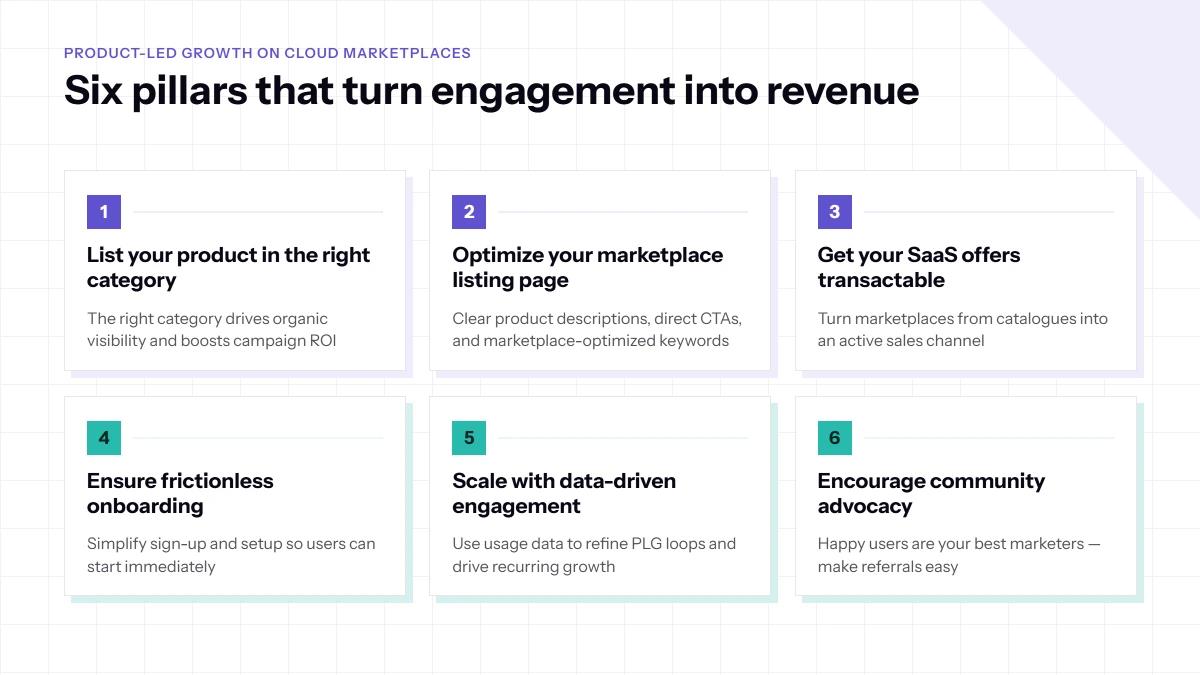
Product-Led Growth (PLG) for SaaS succeeds by design. Its effectiveness comes from a set of core pillars that guide how products are built, experienced, and scaled. For ISVs, understanding these pillars is essential to translating product engagement into predictable marketplace revenue.

Let’s look at an overview of how these pillars can strategically maximize your conversion rates:

1. List Your Product in the Right Category

Being in the middle of the buyers that actually need your solution is a primary PLG aspect when selling on the cloud marketplaces. This not only helps you gain organic visibility but also boosts your campaign performance.

Moving ahead, after a duration, you get the buyer’s specific insights and opportunities to pitch cross-sell and up-sells.

2. Optimize Your Cloud Marketplace Listing Page for Better Engagement

Your marketplace listing is often the first interaction buyers have with your SaaS product. To make that moment count, ensure your listing is not just informative, but conversion ready.

  • Add meaningful CTAs like “Request Demo” or “Request Private Offer” to drive engagement.
  • Communicate your product’s value clearly with a detailed description and use fit examples.
  • Optimize your listing content for marketplace search by using relevant keywords, accurate categories, and clear metadata.

3. Get Your SaaS Offers Transactable

This is the key to PLG strategy success when selling on cloud marketplaces. Many ISVs still use cloud marketplaces as a digital catalogue to reach and invite customers for deal negotiation.

What if your offer sells itself by delivering a first-hand usage experience? Product-led growth for SaaS on cloud marketplaces primarily revolves around offering customers a free demo experience. Most ISVs leverage freemium and free trial models to engage customers and build relationships quickly.

4. Ensure Frictionless Onboarding

PLG thrives when users can start using the product immediately, without waiting for approvals or complex setup. Instant trials or freemium versions lower barriers to entry and encourage experimentation.

5. Scale to Data-Driven Engagement

PLG isn’t just about letting users explore; it’s about understanding what they do while they engage. Usage analytics provide insights into adoption patterns, feature popularity, and potential upgrade opportunities.

6. Encourage Community Engagement

A product that delights users naturally becomes a referral engine. Encouraging community engagement and sharing allows satisfied users to advocate for the product, bringing in new customers with minimal additional effort.

The SaaS PLG Challenge for ISVs Selling on Cloud Marketplaces

For ISVs, combining Product-Led Growth (PLG) with cloud marketplace selling feels like a natural next step. After all, marketplaces like AWS, Azure, and Google Cloud are built for discovery, scale, and distribution- the same values that PLG stands on.

But here’s the catch: while marketplaces simplify buying, they often complicate selling.

The operational and technical layers behind a marketplace transaction aren’t designed for the fast, self-serve motion that PLG depends on. And this creates a critical gap for ISVs trying to scale product-led experiences on cloud platforms.

Let’s look at what typically stands in the way:

Onboarding Complexities with Self-Serve Trials in Marketplaces

On paper, offering free trials sounds like the easiest way to let your product do the talking. But in practice, when SaaS vendors try to run trials through cloud marketplaces, the experience can quickly turn complex due to platform-specific rules for listing, activating, billing trials, and technical integration challenges.

That means what should feel like a one-click “try now” often turns into a process involving manual approvals, compliance checks, identity verifications, and environment configurations before a user can even get started.

Manual Offer Creation and Co-Sell Processes

Creating or updating a private offer on cloud marketplaces can be a highly manual process. From setting up custom pricing to handling approvals and configurations, everything takes time.

For PLG-oriented ISVs, this becomes a bottleneck as it delays upgrades, slows down conversions, and adds operational overhead. What should be an instant, product-driven decision turns into a multi-step administrative task.

Complex Pricing and Billing Workflows

Each marketplace has its own billing system and pricing model. Aligning these with product usage data can be tedious and error-prone if done manually.

Automation is the only way to bridge this gap, ensuring that when a user moves from trial to paid, billing updates happen instantly, transparently, and at scale.

Disconnected Product Usage Data and Partner Systems

This is where many ISVs lose the most visibility. Product usage data often sits siloed inside internal systems, while marketplace analytics and partner portals (like AWS ACE or Microsoft Partner Center) live elsewhere.

Without automation, syncing this data manually is not just inefficient; it’s risky. You lose track of which accounts are active, which are ready for co-sell, and which need nurturing.

How Marketplace SaaS PLG + Automation Solve Challenges and Power Scalable Growth

We have seen some key PLG challenges above and how automation transforms the selling experience for ISVs. But the role of automation is not limited; it helps ISVs power scalable growth without adding overhead.

If Product-Led Growth (PLG) is the engine that drives your SaaS forward, automation is the system that keeps it running smoothly at scale.

Think about the full journey of a SaaS buyer: they sign up for a free trial, start using the product, upgrade to a paid tier, and eventually become an advocate. Each of those stages involves multiple operational tasks, provisioning, billing, user tracking, and offer management.

Now, every step you see here has its own self-selling strength:

  • Pricings can signal scalability
  • Private offers can signal customization.
  • Co-selling partners can be your product advocate.

When these workflows are managed manually, the intended message for buyers either misses out, or they find an earlier response from one of your peers. That’s why automation becomes a must-have capacity, quietly taking care of the behind-the-scenes work that makes a frictionless product experience possible.

Without automation, every step would depend on human intervention. With automation, these moments happen instantly and intelligently:

  • Provisioning and billing are triggered automatically through cloud APIs.
  • Usage tracking flows directly into your CRM or partner systems.
  • Trial-to-upgrade journeys become seamless, without sales bottlenecks.

The result? Even without a salesperson’s intervention, your product becomes a self-sustaining growth engine, turning users into paying customers and paying customers into loyal advocates.

Best Practices: Building PLG into Your Marketplace GTM Strategy

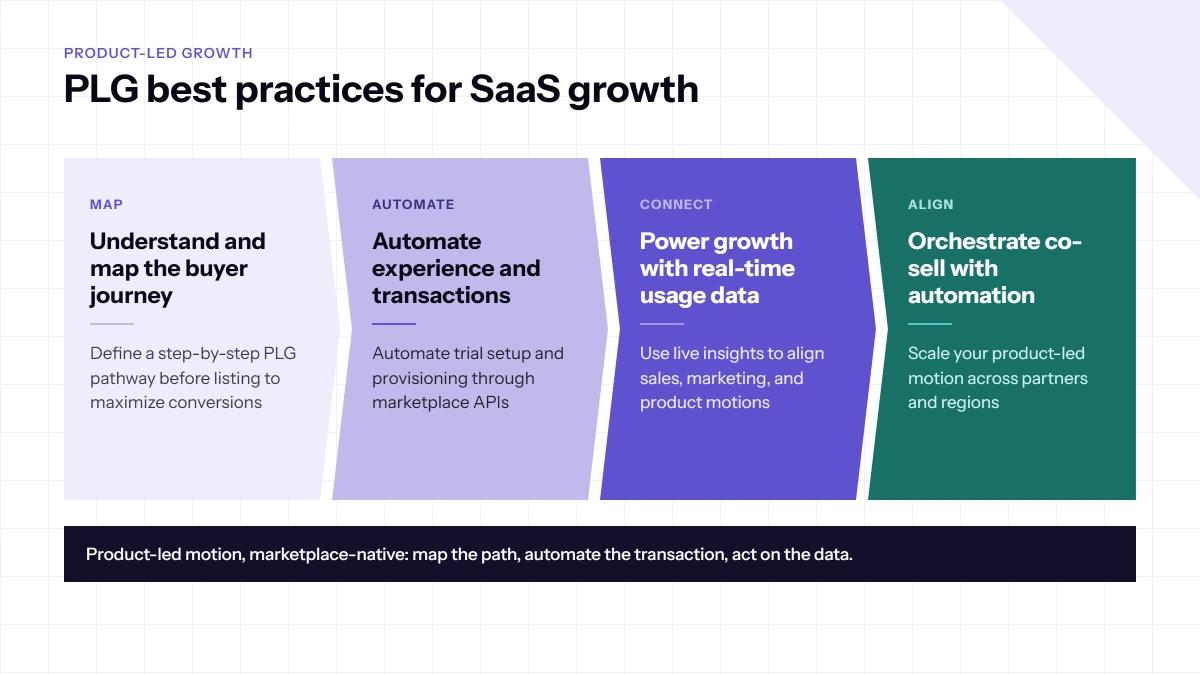
Best practices PLG automation on cloud marketplaces

For Independent Software Vendors (ISVs), Product-Led Growth (PLG) for SaaS on a cloud marketplace becomes truly powerful when it’s intentionally built into your cloud marketplace Go-To-Market (GTM) strategy.

The real goal is to transform product usage into predictable revenue, while keeping the buyer’s journey frictionless, automated, and scalable.

Let’s break down how modern ISVs can make this shift- step by step:

1. Map Your SaaS PLG Journey to Marketplace Listing Flows

Before listing, it’s important to understand how your product actually fits into the marketplace flow.

  • Start by identifying key touchpoints- from trial signup to feature adoption to upgrade triggers.
  • Then, create a plan to map these moments against marketplace workflows like provisioning, subscription purchases, and private offer access.

If you are working with SaaSify, our experts guide you through the intricacies of SaaS PLG step by step, in our pre-onboarding meetings, saving your GTM team's efforts and months of research to identify the right pathway.

2. Automate Provisioning, Trials, and Billing

Once your journey is mapped, the next step is automation.

  • Automate trial creation and provisioning using marketplace APIs so users can start exploring instantly.
  • Enable tiered or usage-based billing workflows that scale with customer value.
  • Enable private offer requests and automate the entire workflow to close deals quickly.
  • Streamline your co-sell partnership and boost your co-sell operations with automated marketplace operations management.

This step-by-step marketplace operations automation ensures a consistent, trusted experience for buyers and reinforces the “product-first” promise of your SaaS PLG.

3. Connect Usage Analytics with GTM Systems

PLG thrives on data, but that data only creates impact when it’s visible across teams. Leverage SaaSify-powered real-time data inflow into your native CRM to make tailored cloud and co-sell GTM strategies.

  • Highlight those who’ve explored core features or exceeded usage thresholds as your next co-sell or upsell opportunities.
  • Use these insights to refine your onboarding flows, enhance features, and keep your sales and marketing motions perfectly aligned.

When teams operate with real-time visibility, every action becomes smarter, faster, and more relevant.

4. Align Co-Sell Teams Through Automation

Cloud marketplaces are partner ecosystems, a step beyond just storefronts. To succeed, your SaaS Product-led Growth must work hand-in-hand with co-sell motions.

  • Trial or usage data can trigger alerts to co-sell teams.
  • Deal readiness can be flagged automatically.
  • Private offers can be generated dynamically based on engagement or usage milestones.

This kind of orchestration makes your product-led motion scalable across partners and regions.

How SaaSify Redefines PLG and Powers Scalable Growth for Marketplace-Driven ISVs

If Product-Led Growth (PLG) for SaaS is about creating a product that sells itself, then SaaSify is about making that self-selling process operationally effortless.

The operational ease becomes critical in the complex marketplace ecosystem where different platforms (AWS, Azure, and GCP) have different sets of rules. The evolving layers of billing, provisioning, and reporting often slow down a self-serve motion.

That’s where SaaSify bridges the gap between your product experience and the marketplace machinery behind it. Instead of building custom workflows for onboarding, billing, or co-sell alignment, you get an intelligent automation layer that runs quietly in the background.

Here’s how that looks in action:

1. Instant Trials and Automated Provisioning

SaaSify integrates directly with marketplace APIs to deliver frictionless trial experiences. When a user signs up, the trial instance is provisioned instantly, and usage tracking begins automatically- no manual setup or approvals required.

2. One-Click Upgrades through Private Offer Automation

SaaSify bridges the trial-to-paid conversion gap by auto-generating private offers with pre-set pricing and configurations. This ensures users upgrade at peak engagement, before the free trial ends, creating a seamless transition from exploration to purchase.

3. Data-Driven Insights for Smarter Product Decisions

SaaSify offers analytics that help PLG and GTM teams understand real usage patterns. You can optimize pricing, packaging, and buyer journeys based on actionable data rather than assumptions.

4. Built-In Co-Sell Workflows with Cloud Partners

SaaSify syncs CRM, marketplace, and partner data so co-sell operations flow seamlessly from one unified dashboard. HubSpot and Salesforce users get native connectors for real-time visibility, while others manage co-sell flows without switching tools.

5. Simplified Billing and Revenue Operations

A strong PLG motion depends on seamless monetization. SaaSify automates billing and invoicing across clouds, aligning usage data with marketplace transactions, eliminating manual reconciliation or delays.

6. Unified View Across Product, Sales, and Marketplace Teams

SaaSify centralizes operational, product, and revenue insights, giving every team a shared source of truth. This alignment transforms PLG from a marketing approach into a measurable, revenue-driven system.

When these elements work together, every signup, upgrade, and data signal feeds directly into your marketplace GTM and CRM systems.

The result: your product becomes a self-sustaining growth engine with the product at the center, operations on autopilot, and data driving every next move.

Way Forward: Turning SaaS PLG and Automation into Your Growth Advantage

Product-Led Growth is the new rhythm of SaaS success on the cloud marketplaces. The modern buyer doesn’t want to be sold to; they want to explore, experience, and decide on their own terms.

When your SaaS product can sell itself, and your operations can run themselves, you unlock a systematic approach to scaling your SaaS growth on the cloud marketplaces, without increasing overhead.

That’s the power of Product-led Growth for SaaS on the cloud Marketplaces. When you power it with automation, it becomes a scalable, repeatable motion.

By bringing automation, intelligence, and marketplace readiness under one roof, SaaSify makes it possible for your product to reach buyers across AWS, Azure, and Google Cloud, without the operational drag that usually slows growth down.

The result?
A scalable, data-driven SaaS PLG motion that connects product, marketing, and revenue into one seamless system of growth.

With SaaSify, that transformation isn’t just possible. It’s already happening.

Book a free demo

FAQs

1. What does Product-Led Growth (PLG) mean for SaaS companies?

Product-Led Growth for SaaS is a go-to-market strategy where the product itself drives user acquisition, conversion, and expansion. Instead of relying primarily on sales or marketing outreach, PLG focuses on letting users experience value firsthand through free trials, freemium plans, or usage-based models that naturally lead to paid adoption.

2. How does PLG apply to cloud marketplaces like AWS, Azure, or GCP?

Cloud marketplaces provide the perfect environment for PLG because they enable users to discover, try, and buy software directly within their existing cloud accounts. When PLG motions are connected to marketplace transactions, ISVs can scale faster, shorten sales cycles, and access enterprise budgets already committed to the cloud.

3. Why is automation important in Product-Led Growth?

Product-led Growth strategy thrives on speed and self-service. Automation ensures that every step of your PLG workflow deliver consistent experiences, capture real-time usage data, and turn your growth experiment into a measurable, scalable motion.

4. How does SaaSify help ISVs automate PLG on cloud marketplaces?

SaaSify bridges the gap between PLG workflows and marketplace operations. It automates provisioning, billing, and private offer creation, while syncing product usage data with CRMs and partner systems like ACE and Partner Center. This allows ISVs to manage their entire PLG-to-marketplace lifecycle from one platform, without custom engineering.

5. How do ISVs measure success in PLG without relying solely on revenue?

Beyond revenue, ISVs should track engagement metrics like trial activation, feature adoption, usage-to-upgrade conversion rates, and customer advocacy signals. These early indicators show whether the product is resonating and provide insight for scaling GTM efforts.

6. What are the risks if PLG flows are not aligned with marketplace operations?

If trials are delayed, offers are manual, or usage data is disconnected, ISVs risk:

  • Lower trial-to-paid conversion
  • Slower revenue capture
  • Reduced co-sell effectiveness
  • Poor user experience that could affect retention

PLG only achieves its potential when product-led experiences are supported by operational readiness and marketplace alignment.

Grow your partnership revenue

See how SaaSify pairs an agentic Cloud GTM platform with hyperscaler experts to multiply your partnership revenue.