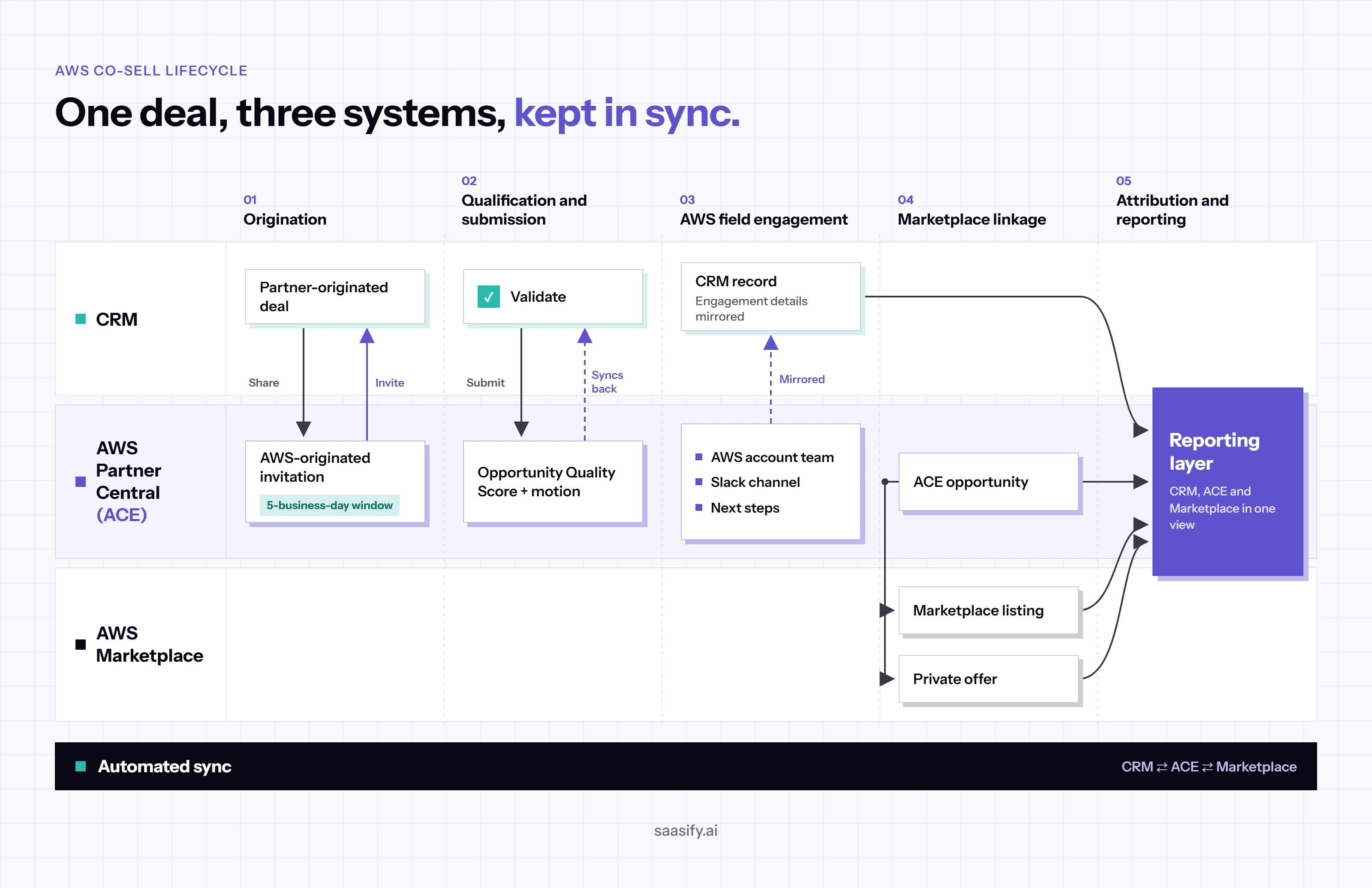
Automation makes co-sell operationally scalable. But the deals themselves are won on the relationship, the enablement, and the operating rhythm you build with the AWS field. Three levers matter most.
Earn AWS field mindshare
AWS-originated opportunities are particularly valuable because AWS has already identified an active customer opportunity and determined that a partner may be relevant to it. AWS's documentation describes how its recommendation model works: for software partners, it uses solution listing quality, product category and description, customer deployment signals, past opportunities, and past performance.
Six things improve your chances of being visible and useful to the AWS field:
A high-quality Marketplace listing and clean solution metadata: ambiguous or generic listings give AWS's recommendation systems fewer useful signals for matching your solution to relevant opportunities.
A track record of launched ACE opportunities: launched opportunities and past execution give AWS additional evidence about where your solution has successfully won.
Marketplace transactability with the SaaS Co-Sell Benefit active: AWS account managers get quota credit when co-sold deals transact through Marketplace private offers with ISV Accelerate partners.
A responsive operating rhythm on the deals you already have: fast ownership on AWS-originated invitations and steady stage progression signal that sharing more opportunities with you is a good use of the field's time.
A PDM who understands where your solution wins: your Partner Development Manager can translate your solution more effectively to the AWS field when they know what's working.
Competencies and Specializations tied to your ACE activity: these signal validated expertise, and AWS uses them to build recommendation confidence.
Consistently bring opportunities to AWS field sellers
Waiting passively for AWS-originated invitations leaves most of the co-sell opportunity untapped. The stronger position is a steady outbound flow of qualified Partner-originated opportunities the AWS field can engage on.
Four practices make this repeatable:
Build a monthly account map with your PDM: identify target accounts where you have signal and AWS has an account team, and prioritize the overlap.
Submit early, not only when the deal is ready: ACE submissions at the discovery or qualification stage give the AWS account team time to engage before terms are locked.
Bring warm intelligence, not just names: each Partner-originated opportunity should carry customer context (use case, technical fit, timing) that makes it worth the AWS seller's engagement.
Follow up with outcomes: when a Partner-originated opportunity closes, share the outcome back with the account team and the PDM. Consistent close-the-loop reporting increases the odds of AWS-originated flow later.
Build joint collateral AWS field sellers actually use
Most ISV enablement is written for the ISV's own sellers, not for an AWS account manager who has thirty seconds to explain your solution in a customer meeting. A joint collateral pack that actually gets used is typically four short, customer-facing assets:
A one-page joint solution brief: what the ISV solution does with AWS, which AWS services it uses, and the customer problem it solves. One page, customer-facing, built using the appropriate AWS Partner brand treatment.
A three-slide field pitch: customer problem, joint solution and architecture, outcomes with a named reference customer.
A one-page battle card: common customer questions, competitive differentiation, discovery questions the AWS seller can ask, and clear signals of when to bring the ISV in.
A short customer-facing demo or reference architecture: a five-minute walkthrough or a labeled architecture diagram AWS SAs can share directly with a customer.
Checklist for making sure each asset actually gets picked up:
Use approved AWS Partner brand treatments and follow AWS's current partner branding guidance.
Lead with the customer problem, not the product.
Name the AWS services your solution uses.
Include one enterprise reference customer with a specific outcome.
Add three specific discovery questions the AWS seller can ask.
Confirm Marketplace transactability and pricing signal.
Provide a named partner contact, not a marketing inbox.
Keep Partner Central positioning aligned, so the solution description, use cases, Marketplace listing, and field collateral tell the same story.
Set an operating cadence AWS sellers can rely on
Three cadences matter:
Response cadence on AWS-originated invitations, measured in hours, not days.
Stage-update cadence on active co-sell opportunities, so the AWS account team sees progress without asking.
Quarterly business rhythm with your PDM, covering pipeline, wins, joint enablement, and upcoming deals worth flagging.
Automation makes each achievable at scale.